
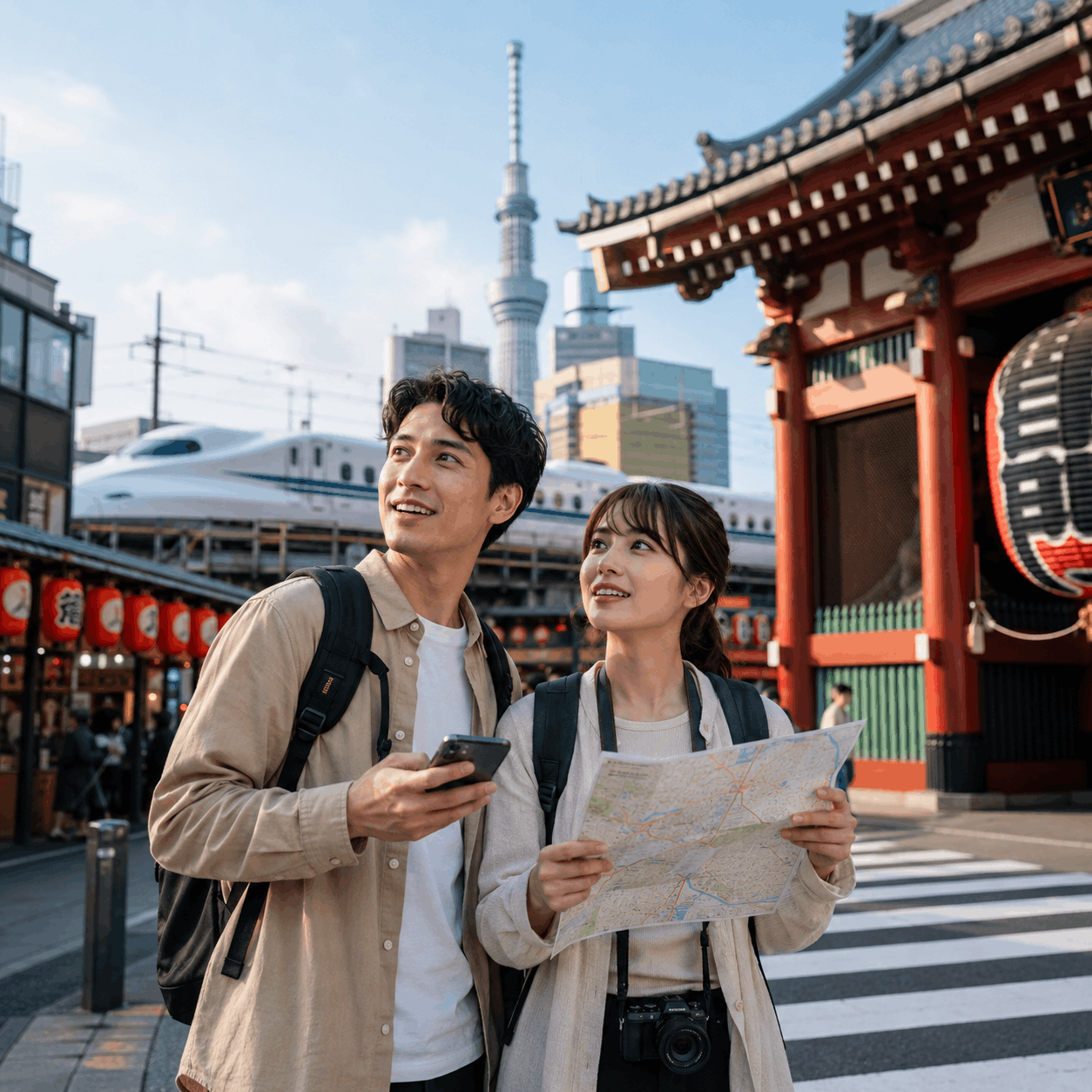
Japan is one of those destinations that makes people weird.
Not in a bad way. In a “I have been watching Japan videos for 7 months, saved 94 Instagram reels, built a colour-coded Google Map, and still have no idea what I’m actually doing” kind of way.
And honestly, fair enough.
Japan does that to people.
It is one of the easiest countries in the world to admire from a distance, and one of the easiest countries to accidentally overcomplicate when you are trying to plan your first trip.
Because the problem is not that Japan lacks options.
The problem is that Japan has too many good ones.
Too many neighborhoods that look cool.
Too many train passes that sound important.
Too many “must-see” lists written by people who apparently do not need sleep.
Too many first-timers trying to squeeze Tokyo, Kyoto, Osaka, Nara, Hakone, Hiroshima, Hokkaido, Okinawa, and a spiritual rebirth into 9 days.
So let’s calm the chaos down a little.
Here is what you actually need to know before going to Japan for the first time.
1. Japan is not “hard,” but it does punish bad planning
Let me say this first: Japan is not some impossible puzzle box.
It is clean, organized, safe by global standards, and built on systems that generally work very well. English is also commonly understood in major cities, airports, and many tourist areas, even if not everyone speaks it fluently.
But.
Japan is also the kind of place where small planning mistakes multiply fast.
Pick the wrong area to stay in? You add 30–45 minutes of unnecessary transit to every day.
Overstuff your itinerary? You spend half your trip dragging luggage, missing the mood entirely.
Assume the rail pass is automatically worth it? Congratulations, you may have paid extra for the privilege of feeling organized.
Japan rewards people who think a little before moving.
Not overthink.
Just enough to stop making their own lives harder.
2. Do not try to “do Japan” in one trip
This is the biggest first-timer mistake.
People treat Japan like a checklist instead of a country.
Tokyo is not a day trip from your imagination. Kyoto is not just “the temple one.” Osaka is not just “food city.” Hokkaido is not casually attached to the rest of your itinerary because you saw snow in a reel and got emotional.
Your first Japan trip does not need to be comprehensive. It needs to be coherent.
For most first-timers, a classic route like Tokyo + Kyoto + Osaka, or even just Tokyo + one other base, is more than enough. If you have around 10 to 14 days, then yes, you can move around a bit. If you have 7 to 9 days, calm down. Pick fewer places and enjoy them properly.
Because the trip you actually enjoy is better than the trip that looks impressive on paper and leaves you spiritually concussed.
3. The JR Pass is not automatically worth it anymore
A lot of first-time Japan planning still gets infected by old advice.
For years, people heard “Just get the JR Pass” as if it were some sacred travel relic handed down by wise train monks.
Now? Not necessarily.
The official Japan Rail Pass still exists, but after the price increases, it is no longer the obvious default for many travelers. Current official prices for ordinary passes are 50,000 yen for 7 days, 80,000 yen for 14 days, and 100,000 yen for 21 days. It can still make sense for some long-distance itineraries, but it is very much not a universal no-brainer anymore.
This means a lot of first-timers need to stop asking:
“Should I get the JR Pass?”
and start asking:
“Am I actually taking enough long-distance JR trains to justify it?”
Very different question.
If your trip is mostly Tokyo, Kyoto, and Osaka with modest intercity movement, point-to-point tickets may be better. If you are doing a more aggressive multi-city route, then maybe the pass still has a place.
But please, do not buy it just because the internet said “Japan = trains = rail pass.”
That is not planning. That is ceremonial spending.
4. IC cards matter more for daily life than the JR Pass does
If the JR Pass gets too much attention, IC cards often do not get enough.
For daily convenience, IC cards like Suica or Pasmo are often far more relevant to how your trip actually feels. JNTO notes that IC cards can be used on trains, buses, and even at some convenience stores, vending machines, taxis, and other services, which is why they become so useful for everyday movement.
This is the thing that makes local transit smoother.
Instead of buying a separate ticket every time you blink near a train station, you tap in and go like a civilized person.
For first-timers, that matters a lot.
Because Japan’s transport system is excellent, but the first few days can still feel like you are being judged by a very efficient machine.
An IC card helps reduce the friction.
5. Set up your entry stuff before you fly
Japan uses Visit Japan Web, which lets travelers register immigration, customs, and tax-free shopping information before arrival and generate QR codes for entry procedures.
This is one of those profoundly boring things that becomes extremely interesting the moment you land tired, dehydrated, mildly confused, and holding your passport like it personally betrayed you.
Do it before the trip.
Not because it is glamorous.
Because airport admin is one of the worst places to improvise.
Also, if you are a Canadian traveler, check the official Government of Canada travel advice page for Japan before departure and consider using the Registration of Canadians Abroad service, which allows the government to contact you in emergencies or major disruptions.
Again, not sexy.
Very useful.
6. Japan is more cash-friendly than some people expect, but less “cash-only” than outdated advice makes it sound
A lot of people still show up to Japan armed with one dramatic warning:
“Japan is cash only.”
That is too simplistic.
JNTO’s current planning resources still explicitly cover currency, tax-free shopping, and card/cash logistics, which tells you the issue still matters. At the same time, the infrastructure for IC cards, convenience-store payments, and broad urban connectivity makes modern Japan much easier than the old stereotype suggests.
The sensible version is this:
- bring a card that works internationally
- have some cash on hand
- do not assume every tiny place loves your foreign card
- do not panic and carry enough yen to purchase a used sedan
Large cities are easier. Smaller places can be less flexible. Convenience stores are your friends. Japan is not trying to ruin your life. It is just not obligated to revolve around your debit card either.
7. Internet matters more in Japan than people think
Some destinations let you wander around and improvise with vibes.
Japan is not really that destination.
In Japan, having working data is extremely helpful for:
- station navigation
- train timing
- maps
- translation
- restaurant lookups
- emergency re-routing when you boarded the wrong thing and are pretending this was intentional
JNTO says Japan’s major international airports offer free Wi-Fi, and for short-term visitors, eSIMs and pocket Wi-Fi are especially convenient.
So yes, sort out your connectivity before or upon arrival.
Because “I’ll just figure it out” sounds brave until you are in a station the size of a minor civilization.
8. Where you stay matters almost as much as what you do
This one gets underestimated constantly.
People get obsessed with hotel stars, room size, and whether the bathtub looks poetic enough, then book a place in an area that quietly makes the whole trip worse.
In Japan, especially in big cities, location is leverage.
Being near the right station or in the right neighborhood affects:
- how tired you get
- how often you need transfers
- whether evenings feel fun or annoying
- whether you can pop back to your hotel without making it a quest line
A slightly worse hotel in the right area often beats a nicer hotel in the wrong one.
This is especially true in Tokyo, where “Tokyo hotel” tells you almost nothing by itself.
Tokyo is not one mood.
It is several different cities wearing one name tag.
9. Cherry blossom season is beautiful, yes — and also crowded, expensive, and emotionally overbooked
Spring in Japan is gorgeous. Of course it is. That is why the entire planet tries to arrive at once.
Japan’s official tourism resources continue to heavily promote sakura season and regional bloom timing because it remains one of the country’s biggest travel draws.
But first-timers should understand what that means in practice:
- more demand
- higher accommodation pressure
- more crowds
- more need for advance planning
- more competition for the “dream version” of the trip
So yes, cherry blossom season is magical.
It is also not automatically the best season for you.
Sometimes first-timers are better off going in autumn, winter, or shoulder season if they want a smoother, calmer, or better-value trip.
Beauty is not the same thing as fit.
This is true in Japan, and honestly in life.
10. Tax-free shopping exists, but the rules are changing
Japan currently allows eligible non-residents to receive tax exemption on many purchases, usually by presenting a passport at designated tax-free shops. JNTO also notes that this system is scheduled to shift to a refund-based model starting November 1, 2026.
So if you are traveling before that date, you are generally dealing with the current system. If you are traveling after that point, double-check the updated process closer to your departure.
This is a good example of why Japan planning advice ages badly online.
You do not want to build a shopping strategy based on a blog written in the Jurassic era of 2023.
11. Etiquette matters, but do not turn it into a moral panic
Japan etiquette advice online can get silly fast.
You would think if you accidentally stand in the wrong part of an escalator the country will gently exile you.
Relax.
Yes, etiquette matters. JNTO maintains dedicated guidance for travelers on manners and practical conduct.
But for first-timers, the important version is simple:
- be quiet on transit
- do not block pathways
- follow signs
- be respectful in temples, shrines, and local neighborhoods
- do not treat every place like your personal content studio
- observe first, then act
You do not need to become a cultural performance artist.
You just need enough awareness to not move through Japan like the world is one giant airport lounge built for your convenience.
12. Japan is very safe by tourist standards, but “safe” is not the same as “switch your brain off”
Japan is widely regarded as a safe destination, and that is one reason first-timers love it. But the Government of Canada still advises travelers to exercise a high degree of caution, and specifically notes the risk of drink spiking, fraud, and theft in nightlife districts such as parts of Tokyo and entertainment areas in other cities.
So the correct mindset is not fear.
It is adult-level situational awareness.
Enjoy yourself.
Just do not become stupid because the country is organized.
A clean train platform is not a magical anti-consequence field.
13. The biggest mistake is building a trip for an imaginary version of yourself
This is the real problem underneath all the others.
A lot of first-time Japan trips are built for the traveler people wish they were.
The hyper-efficient early riser.
The shrine-hopping minimalist.
The anime pilgrim with endless energy.
The urban explorer who can happily cross the city six times in one day and call it “spontaneous.”
And then real life happens.
Feet hurt.
Jet lag hits.
Train stations become boss fights.
Someone discovers that maybe they do not actually want six neighborhoods, two museums, one shrine, a character café, teamLab, vintage shopping, and omakase in a single Tuesday.
So before you plan Japan, ask a better question:
What kind of traveler are you when you are actually on the ground?
That question matters more than the algorithm’s idea of what your trip should look like.
My Thoughts
Japan is a phenomenal first major trip.
But it is not phenomenal because you can “do everything.”
It is phenomenal because even a relatively small slice of it can feel rich, specific, and memorable if you plan with some honesty.
Not fear.
Not overplanning.
Not chaos.
Just enough structure to let the trip breathe.
So if you are going to Japan for the first time, here is the short version:
- do not overpack your itinerary
- think carefully about your bases
- do not assume the JR Pass is automatically worth it
- get an IC card mindset for daily movement
- set up your entry steps in advance
- sort out internet early
- keep some cash
- respect the place
- plan for the traveler you really are, not the cinematic version of yourself
That is usually where the good trip begins.
Still figuring out what kind of Japan trip actually fits you?
This is where a lot of people get stuck.
Not because Japan lacks options.
Because it has too many.
One person wants Tokyo energy, shopping, food, and nightlife.
Another wants slower ryokan stays, quieter towns, and a trip that does not feel like a tactical sprint between train platforms.
Another thinks they want “all of Japan,” when what they actually need is a cleaner route and fewer hotel changes.
That is exactly why we built our Japan travel planning route.
If you are still in the early stage of planning, you can start with our Japan Trip Finder to get a clearer sense of what kind of trip fits your style, pace, and interests.
If you are already further along and want real help putting the trip together, you can explore our Japan packages and planning options here:
Explore Japan Packages
Try the Japan Trip Finder
Because the best Japan trip is usually not the one with the most places.
It is the one that actually fits you.
Comments
0 comments
No comments yet
Be the first to add a thought or question about this article.