
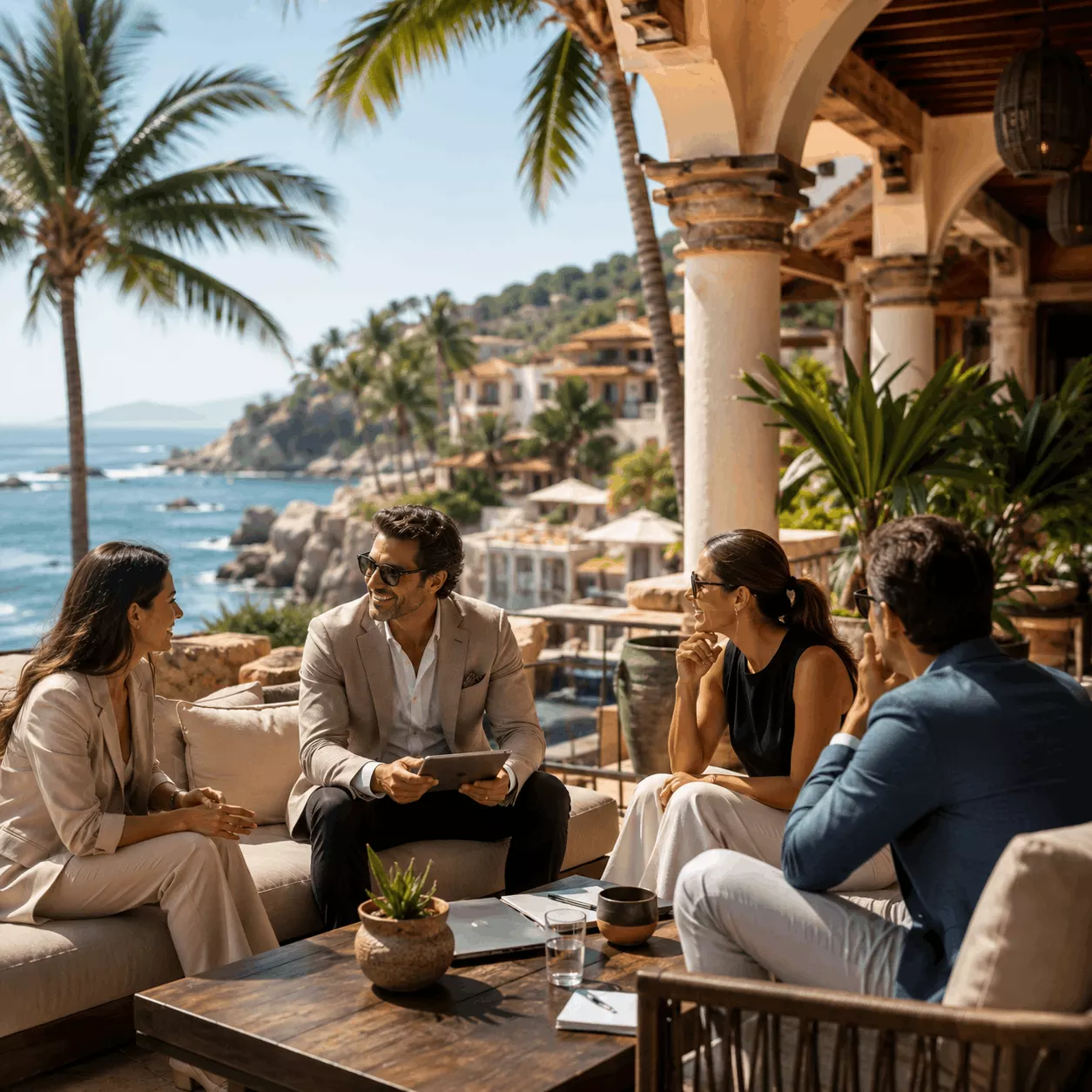
Corporate travel is one of those things people talk about like it’s glamorous.
In reality, it is usually one stressed organizer, three indecisive managers, one finance person sharpening a knife in Excel, and thirty adults pretending they are “easygoing” right until room assignments begin.
And yet, Mexico remains one of the best places to do it.
Not because it is cheap.
Not because it is sunny.
Not because someone in leadership said, “Guys, we deserve this.”
No.
Mexico works because, when done right, it gives you that rare thing in group travel:
ease with style.
That is the sweet spot.
That is the groove.
Not just “nice beach, good luck everybody.”
No, no.
I mean a trip where the flights make sense, the transfer doesn’t spiritually wound the group upon arrival, the resort actually fits the company, the food is not tragic, the executives are comfortable, the social people have places to yap, the quiet people have places to vanish, and the poor soul organizing the whole thing does not spend four days doing emotional janitorial work in paradise.
That is a good corporate trip.
That is art.
First, let us kill a bad idea
The bad idea is this:
“We want to do corporate in Mexico.”
Lovely. Stunning. Poetic.
That is not a plan.
That is the opening line of a problem.
Because “Mexico” is not one thing.
Mexico contains multitudes.
Some of those multitudes are elegant.
Some are loud.
Some are smooth.
Some are trying very hard to sell your vice president a foam party he did not ask for.
So before you start tossing resort names into a group email like divine revelation, ask the real question:
What kind of group is this?
Because that changes everything.
Are we dealing with:
- a polished leadership retreat
- a sales incentive group
- a reward trip for top performers
- a mixed company offsite with different ages, personalities, and alcohol tolerances
- a client-facing trip where perception matters almost as much as reality
- a “team bonding” event that everyone will resent if it smells even slightly forced
These are not the same species of trip.
You cannot feed them the same resort and call it strategy.
Corporate travel is not leisure travel wearing a name tag
This is where people get lazy.
They think,
“Well, I’d enjoy this resort on vacation, so surely fifty coworkers from different departments will also enjoy it under the weird social pressure of being semi-off-duty but not fully free.”
No.
A family trip can survive on chaos.
A couple’s trip can survive on chemistry.
A friend trip can survive on shared stupidity.
A corporate trip survives on design.
Because the thing you are really managing is not just travel.
You are managing:
- hierarchy
- awkwardness
- expectations
- exhaustion
- image
- budget
- timing
- energy
- and that one guy who always says “I’m chill with whatever” right before becoming very, very not chill with whatever
So the job is not to book a place.
The job is to build an environment where nonsense has fewer places to hide.
What companies actually want, beneath all the corporate perfume
Every corporate planner says some version of:
“We want a memorable experience.”
“We want people to connect.”
“We want something special.”
Yes, yes, wonderful.
But beneath the perfume, what they really want is this:
They want the trip to work.
They want:
- no embarrassing mistakes
- no sloppy logistics
- no endless confusion
- no budget ambush
- no janky handoffs
- no feeling that the whole thing was improvised by cousins in a WhatsApp group
They want confidence.
They want to know that when their staff or clients land, things unfold with a certain calm inevitability.
That is luxury, by the way.
Not just marble lobbies and mood lighting.
Luxury is when people do not have to wrestle the trip.
Luxury is when the trip does not ask them to become problem-solvers in linen.
Why Mexico works for corporate when it works
Mexico is strong because it offers range.
You can do quick and efficient.
You can do polished and executive.
You can do festive without becoming tacky.
You can do reward-trip energy without the whole thing turning into a badly supervised bachelor party with expense reports.
There is enough infrastructure, enough resort variety, enough flight access, and enough familiarity that people are not walking into the unknown.
That matters more than people think.
Corporate groups do not really want adventure.
Not true adventure.
They want the feeling of leaving ordinary life without losing the protections of civilization.
They want escape with railings.
Mexico is excellent at that.
Cancun is not automatically the answer, relax
Now let us speak honestly.
A lot of people hear “corporate Mexico” and immediately lock onto Cancun like it descended from the heavens with a clipboard.
Cancun can absolutely work.
But it is not the answer by default just because it is famous and the airport is busy.
Sometimes Cancun is right because it is efficient, familiar, and easier for short trips.
Sometimes Riviera Maya is better because the group wants more breathing room and less “hotel zone, baby.”
Sometimes Costa Mujeres is the sweet spot because it feels cleaner, calmer, and a little more composed.
This is why the planner must resist the urge to treat Mexico like a vending machine.
You do not just press “beach” and get the correct result.
You have to think about the rhythm of the group.
Yes, rhythm.
Because every group has one.
Some groups are high-energy and social.
Some groups are polished but restrained.
Some groups want luxury but hate anything that feels showy.
Some groups want activities until they remember they are tired.
Some groups want to “connect” for exactly ninety minutes and then return to the sacred privacy of their own existence.
A good planner reads that rhythm and books accordingly.
A bad planner books a resort because the photos were shiny.
Transfer time is where the soul leaves the body
I have said this before and I will continue saying it until the sun collapses into itself:
Transfer time matters more than people think.
Especially for corporate.
Because leisure travelers can sometimes absorb inconvenience with a cocktail and a bad joke.
Corporate groups are different.
They arrive carrying:
- fatigue
- social awareness
- hierarchy tension
- emails still haunting them
- the vague hope that this trip was worth saying yes to
So if you take that fragile state and then slam it into a messy arrival process, long wait times, confusing pickups, unclear instructions, and a transfer long enough to inspire personal reflection, you have already damaged the mood.
Maybe not fatally.
But you have nicked the aura.
And that matters.
Because group morale is weird.
It is soft clay in the beginning.
The first few hours matter a lot more than brochure writers admit.
All-inclusive helps, but it is not a magic spell
People treat all-inclusive like it automatically solves complexity.
It does not.
It merely contains complexity better than some other options.
Which is useful.
Very useful.
For corporate groups, all-inclusive can make budgeting easier, reduce friction around meals and drinks, and simplify the general shape of the experience.
But that does not mean every all-inclusive is fit for corporate use.
Some are too loud.
Some are too family-heavy.
Some are too romance-coded.
Some are too spread out.
Some are stylish in photos and operationally irritating in real life.
Some are perfect for a couple celebrating an anniversary and completely wrong for an executive retreat where people need smooth dining, functional flow, and maybe a private event space that does not feel like an airport conference room with tropical wallpaper.
So the question is never merely,
“Should we do all-inclusive?”
The real question is:
Which kind of all-inclusive solves this group’s problems without introducing new ones?
That is where the game becomes interesting.
The true enemy of the corporate trip: forced fun
I must say something unpopular.
A lot of corporate trips become worse the moment someone starts trying to make them “memorable” too aggressively.
Calm down.
Adults do not need to be hunted into fun like nervous cattle.
You do not need to over-choreograph everything.
You do not need a full itinerary from sunrise to midnight.
You do not need to force “engagement moments” every three hours like the group is an under-stimulated classroom.
People need room.
They need elegance.
They need optionality.
They need enough structure that things feel intentional, but not so much structure that the trip feels like punishment with ocean views.
A good corporate Mexico trip has rhythm:
- a smooth arrival
- a bit of breathing room
- a strong dinner
- an activity that actually suits the group
- space for casual connection
- enough freedom that people can return to themselves
That is what works.
Not panic-scheduled joy.
Luxury is not gold trim, it is reduced friction
This is perhaps the biggest misunderstanding.
Luxury in corporate travel is not merely aesthetic.
Luxury is not just:
- a chandelier
- a premium room category
- a rooftop bar with candles trying their best
Those things can help. Fine.
But real luxury, in the corporate sense, is when the group moves through the trip without having to fight it.
That means:
- easy arrival
- proper transfers
- thoughtful rooming
- correct property choice
- dining that flows
- clear communication
- strong pacing
- the right balance between togetherness and escape
- senior people feeling appropriately handled
- the organizer not slowly disintegrating in silence
Luxury is operational grace.
Everything else is garnish.
So what should you actually do?
Start with the truth of the group.
Not the fantasy version.
Not the aspirational LinkedIn version where everyone is dynamic, adaptable, and thrilled to do sunrise networking by the sea.
The real version.
How do these people travel?
What annoys them?
What level of polish do they expect?
What level of inconvenience will they tolerate before the mood starts leaking out of the room?
Is this about reward, planning, celebration, or status?
Do they need meeting space, private dinners, excursions, upgraded rooms, VIP handling, or just a very smooth container in which they can exist pleasantly together for a few days?
Then build from there.
Destination second.
Resort second.
Pretty pictures second.
First: the human machinery.
That is where the trip is either won or quietly ruined.
My Thoughts
Corporate Mexico planning is not about booking a beach.
It is about choreographing a temporary world.
A world where people can feel taken care of without feeling managed.
A world where the company looks competent without looking stiff.
A world where the organizer gets to exhale, the guests get to enjoy, and the whole experience has enough swing to feel alive but enough structure to not fall apart.
That is the groove.
Not chaos.
Not rigidity.
Not brochure-brain.
Groove.
And once you understand that, Mexico becomes less of a generic destination and more of an instrument.
Play it well, and the whole group feels it.
Play it badly, and suddenly everyone is in paradise checking the transfer chat like it is a hostage update.

Comments
0 comments
No comments yet
Be the first to add a thought or question about this article.