
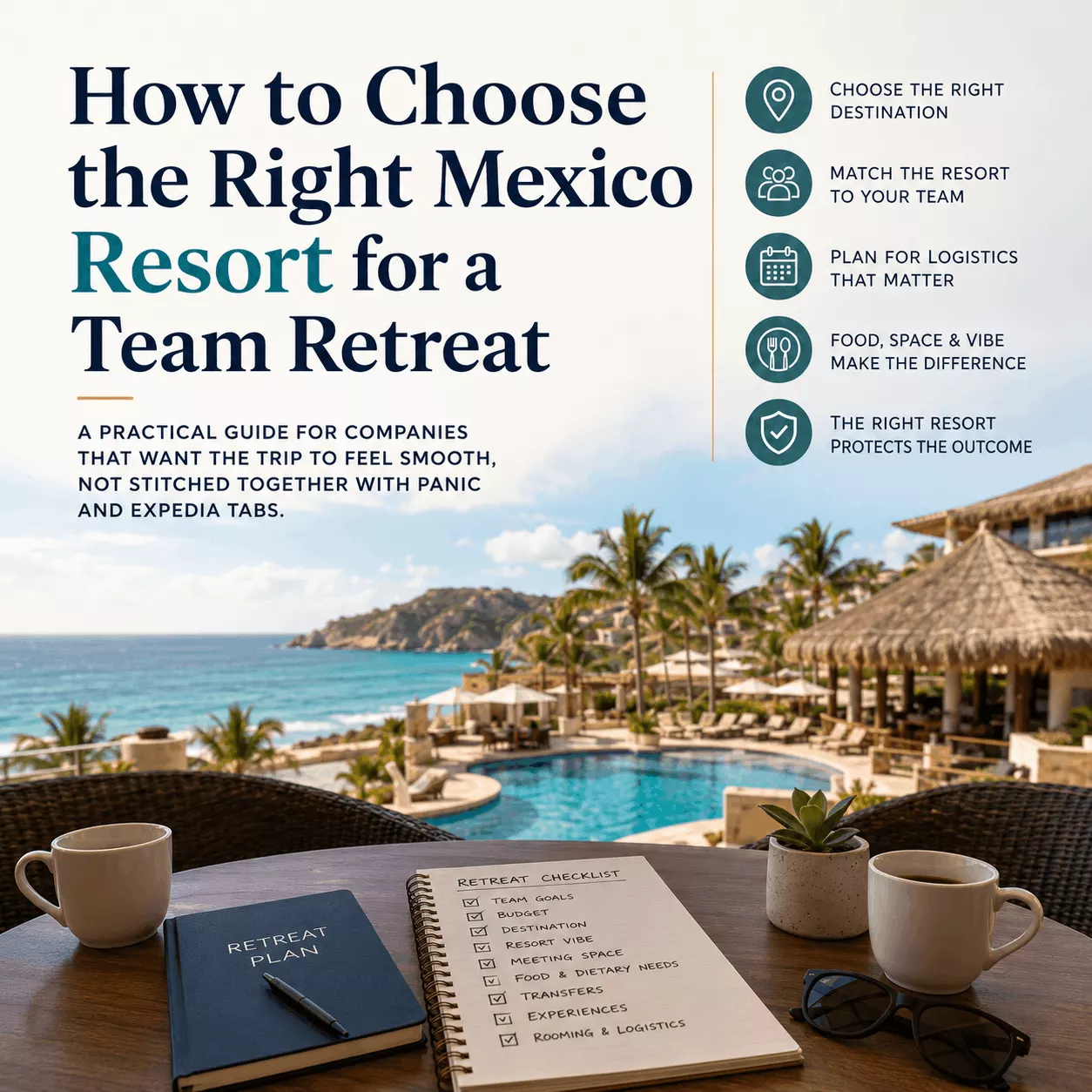
A practical guide for companies that want the trip to feel smooth, not stitched together with panic and Expedia tabs
Planning a team retreat to Mexico sounds simple at first.
You imagine sunshine, a nice resort, maybe a few palm trees behaving politely in the background, your team finally relaxing, everyone laughing over dinner, someone saying, “Wow, we should do this every year.”
Beautiful.
Then reality arrives with a clipboard.
Who is flying from where?
Does the resort have enough rooms?
Is the transfer 25 minutes or two hours?
Is this a party resort?
Is this too quiet?
Will the food work for everyone?
Will the boss be happy?
Will someone complain about the beach?
Will accounting ask for an invoice that makes sense?
Will one person somehow miss the shuttle even though the shuttle was right there?
This is the actual game.
A company retreat is not just “pick a nice resort.” A team retreat has more moving parts than a normal vacation because the trip has to work for different people at the same time. Different personalities, different budgets, different expectations, different levels of travel experience, different definitions of “fun.”
So the goal is not to find the “best” Mexico resort.
The goal is to find the right Mexico resort for your team.
There is a difference.
And that difference is where most retreats either become smooth… or become a cursed group chat with 47 unread messages.
First, define the actual purpose of the retreat
Before you choose Cancun, Riviera Maya, Los Cabos, Puerto Vallarta, or any beautiful resort with professional photography and suspiciously perfect pool water, ask this:
What is this retreat actually supposed to do?
Not “go to Mexico.”
That is the location.
What is the purpose?
A team retreat could be for:
- reward and celebration
- leadership planning
- team bonding
- sales incentive
- rest after a stressful year
- culture-building
- client entertainment
- founder/executive reset
- annual company gathering
Each purpose points to a different type of resort.
A sales incentive trip needs to feel exciting and earned.
A leadership retreat needs privacy, calm, and space to think.
A company-wide retreat needs broad appeal and easy logistics.
A founder trip with a few key people may need quiet luxury, not 2 AM poolside chaos with someone named Chad yelling at the moon.
The worst mistake is picking a resort because it looks “nice.”
Nice for whom?
A honeymoon resort can be terrible for a team retreat.
A party resort can be terrible for a leadership retreat.
A quiet wellness resort can be terrible for a high-energy sales team.
A massive family resort can be terrible if your group wants polish and focus.
The right resort begins with the actual mission.
Match the resort vibe to the team personality
Every resort has a personality.
Some resorts say:
“Come relax, have dinner, sleep early, wake up blessed.”
Others say:
“There will be music, there will be tequila, and your HR department may need to meditate.”
Some resorts are polished and quiet.
Some are energetic and social.
Some are family-heavy.
Some are adult-only.
Some are luxury, but slightly boring.
Some are fun, but operationally chaotic.
Some look incredible online, but the layout is massive and everyone spends the trip walking like they accidentally signed up for a Fitbit challenge.
For a team retreat, the vibe matters because your group has to inhabit the resort together.
Ask:
- Is your team high-energy or low-key?
- Do they want nightlife or peace?
- Is alcohol central, optional, or best kept in the background?
- Are spouses or partners invited?
- Are kids included?
- Is this a reward trip or a work retreat?
- Do people need meeting space?
- Is the group young, mixed-age, executive-heavy, or family-business style?
- Would people prefer luxury, activity, food, beach, wellness, or convenience?
This is where interpretation matters.
A good retreat does not force your team into the wrong environment.
It reads the room before booking the room.
Do not ignore transfer time
Transfer time is one of those things people ignore until they are sitting in a van, tired, hungry, and silently questioning every decision that led them there.
For a couple on vacation, a longer transfer may be fine.
For a team retreat, it matters more.
Why?
Because groups move slower.
Someone’s flight is delayed.
Someone has checked bags.
Someone needs the washroom.
Someone cannot find their passport even though they were holding it eleven seconds ago.
Someone is texting “where are you guys?” while standing directly beside the group.
Now add a long transfer.
Suddenly the retreat begins not with excitement, but with exhaustion.
This does not mean you must always choose the closest resort. Some farther resorts are absolutely worth it. But you need to make that decision consciously.
Ask:
- How far is the resort from the airport?
- Are most guests arriving around the same time?
- Will the group need private transfers?
- Is the transfer scenic and manageable, or just long and tiring?
- Are there late-night arrivals?
- Are executives or VIPs travelling?
- Is anyone leaving early?
A resort that is perfect on paper can become wrong if the arrival experience is painful.
For team retreats, the trip begins at the airport, not at check-in.
Choose the destination area before choosing the resort
Mexico is not one single “vibe.”
Even within resort-heavy destinations, the experience changes depending on the area.
Cancun Hotel Zone
Best for convenience, nightlife, shorter airport transfers, and groups that want energy.
Cancun can work well for teams that want easy access, strong flight options, and a more social atmosphere. It is usually easier for first-timers and groups that do not want to feel too isolated.
But Cancun can also feel busy, commercial, and less retreat-like depending on the property.
Good for:
- sales teams
- incentive trips
- shorter retreats
- groups that want nightlife
- easy arrivals
Be careful if:
- you want silence
- you want a deep luxury retreat feel
- your team dislikes crowds
Riviera Maya
Best for resort-style retreats, larger properties, more space, and a calmer vacation feel.
Riviera Maya often works well for company retreats because many resorts have stronger “stay on property” experiences. More space, more greenery, more resort immersion.
But transfer times can be longer, and the wrong property can feel too spread out.
Good for:
- team bonding
- mixed-age groups
- retreat-style experiences
- resorts with meeting space
- groups that want beach + relaxation
Be careful if:
- your group has tight arrival/departure windows
- people hate long transfers
- you choose a huge resort without thinking about walking distance
Playa del Carmen area
Best for groups that want resort comfort but also access to town.
This can work if your team wants some independence and does not want to be trapped inside the resort bubble the entire time.
Good for:
- smaller teams
- flexible groups
- people who want restaurants, shopping, and nightlife nearby
Be careful if:
- you need a fully contained retreat
- the group needs a polished all-inclusive environment
Los Cabos
Best for upscale, dramatic, polished retreats with a more executive feel.
Los Cabos can feel more premium and less “classic all-inclusive Cancun energy.” It is especially good for luxury, leadership, incentive, and founder-style trips.
But beach swimmability varies by area, and costs may be higher.
Good for:
- executive retreats
- incentive trips
- luxury positioning
- smaller high-value groups
- west-coast flight access
Be careful if:
- your group expects a classic turquoise swimming beach everywhere
- budget is tight
- you need broad all-inclusive value
Puerto Vallarta / Riviera Nayarit
Best for a warmer, more local-feeling Mexico experience with strong scenery and charm.
This can work beautifully for teams that want something less obvious than Cancun, with a bit more soul and atmosphere.
Good for:
- smaller teams
- relaxed retreats
- west-coast departures
- groups that enjoy culture and scenery
Be careful if:
- you want the easiest “standard corporate Mexico” option
- you need large-scale resort inventory for a bigger group
The point is simple:
Do not pick the resort first.
Pick the retreat environment first.
Then choose the resort that fits.
Meeting space matters, even if you only need “one room”
Many companies underestimate meeting space.
They think:
“We just need a room for a few hours.”
Beautiful. Dangerous sentence.
You need to know:
- Is the room private?
- Is it included or extra?
- Does it have AV?
- Is Wi-Fi reliable?
- Is there natural light?
- Is it near the rooms?
- Is it near loud pool/music areas?
- Can food/coffee be arranged?
- Is the setup boardroom, classroom, theatre, or casual?
- Is there a backup if the space is unavailable?
For a true retreat, meeting space is not just a room. It is the container for the actual purpose of the trip.
If your leadership team is trying to plan the next year, do not put them in a sad beige room beside the buffet where a blender is fighting for its life.
The room matters.
The environment tells people whether this is serious, thoughtful, or just “vacation with a PowerPoint.”
Food is not a side detail
For team retreats, food can quietly make or break the trip.
Not because everyone needs Michelin-level dining.
Because food is one of the few things every person interacts with multiple times a day.
Bad food becomes a daily complaint engine.
Ask:
- Are there enough restaurant options?
- Are reservations required?
- Can groups dine together?
- Are vegetarian, vegan, halal, gluten-free, or allergy needs manageable?
- Is the buffet decent?
- Is room service included?
- Is the food consistent, or just good in photos?
- Are there private dining options for one group dinner?
For your audience especially, this matters.
A South Asian business group, family-business group, or mixed dietary group may have vegetarian needs, spice preferences, religious considerations, or just a general inability to survive on sad lettuce and mysterious beige pasta.
Food is not luxury fluff.
Food is morale.
Decide whether the group should stay together or spread out
Some retreats need everyone close.
Some need breathing room.
A smaller executive retreat may benefit from a boutique or premium section where everyone is nearby.
A larger company retreat may need a bigger resort with more room categories and more activities.
But bigger is not automatically better.
Large resorts can create distance.
People get lost.
Groups split up.
Meeting points become confusing.
Someone says, “I’m by the pool,” as if the resort does not have twelve pools and a lazy river the size of a small province.
For team retreats, layout matters.
Ask:
- Is the resort walkable?
- Are rooms close to meeting areas?
- Are restaurants centralized?
- Is there a shuttle inside the resort?
- Will older travellers struggle?
- Will the group naturally gather, or scatter?
A good retreat needs enough space to breathe, but enough structure to create shared experience.
That balance is delicate.
Think about room categories early
Rooming lists are where innocence goes to die.
For a normal vacation, people book their own room and move on.
For a company retreat, you may need to think about:
- single occupancy vs double occupancy
- executives needing upgraded rooms
- spouses/partners included
- employees sharing rooms or not
- accessible rooms
- king vs two beds
- room blocks
- deposit deadlines
- name changes
- cancellations
- late additions
If this is not handled early, it becomes messy.
A resort may have enough rooms overall, but not enough of the right room type.
Or the price may look fine based on double occupancy, then the budget changes when everyone needs their own room.
This is why you do not want to build the whole trip from a random online price.
The group structure affects the real cost.
Budget should be realistic, not magical
Everyone wants luxury, direct flights, great food, short transfers, beautiful beach, premium rooms, private events, flexible terms, and a low price.
Yes. Wonderful.
I too would like a dragon, a castle, and a tax refund.
For a company retreat, budget has to be honest.
The right question is not:
“What is the cheapest?”
The right question is:
“What level of experience do we need this trip to deliver?”
A rough retreat budget should consider:
- flights
- hotel/resort
- transfers
- meeting space
- group meals
- activities
- travel insurance
- service/planning fees
- contingency
- upgrades/VIP handling
- taxes and resort fees where applicable
If the retreat is meant to reward people, do not make it feel cheap.
If the retreat is meant for leadership planning, do not put the team somewhere chaotic.
If the retreat is meant to build morale, do not choose a resort that creates daily complaints.
The cheapest wrong option is expensive in a different way.
It costs trust.
Look for resorts that reduce decision fatigue
For corporate groups, the best resorts often make things easier.
They have:
- strong airport access
- reliable group handling
- enough dining options
- clear room categories
- decent meeting space
- good transfer logistics
- private event options
- consistent service
- activities on-site or nearby
- a layout that makes sense
- enough quality that the organizer does not spend the whole trip apologizing
The organizer should not be running around solving problems while everyone else relaxes.
That is not a retreat.
That is unpaid operations management in linen pants.
A good resort lets the organizer breathe.
Do not overbuild the schedule
This is another classic mistake.
Companies get excited and plan every hour.
Breakfast. Meeting. Activity. Lunch. Workshop. Team-building. Dinner. Group photo. Mandatory bonding. Optional-but-not-really-optional networking. Sunset moment. Another activity. Someone please release these people.
A retreat needs rhythm.
You need structure, but you also need space.
For most company retreats, a good structure is:
- arrival day: simple welcome, no heavy programming
- main day: meeting/session + group dinner or activity
- free day or lighter day: optional excursions, rest, casual connection
- departure day: simple logistics, no chaos
The resort should support this rhythm.
If your team is exhausted, do not choose a resort that requires constant movement.
If your team is high-energy, do not choose somewhere too quiet.
If your leadership team needs focus, do not place them inside constant entertainment noise.
The resort must match the tempo of the trip.
Make sure the resort fits your company image
This matters more than people admit.
A retreat sends a message.
If the resort is too cheap, the team may feel the company did the bare minimum.
If it is too flashy, it may feel wasteful or tone-deaf.
If it is too party-heavy, it may create HR risks.
If it is too boring, it may fail as a reward.
If it is too luxury-coded, it may create internal optics issues depending on the company.
You need to ask:
“What does this resort say about us?”
A company retreat is not only travel. It is culture made visible.
The wrong resort can communicate the wrong thing.
The right resort says:
“We thought about this. We chose carefully. You matter enough for us to do this properly.”
That is the feeling you want.
The best resort is the one that protects the outcome
This is the core.
The right Mexico resort for a team retreat is not always the prettiest one.
It is the one that protects the purpose of the trip.
It protects the organizer from chaos.
It protects the company from embarrassment.
It protects the budget from nonsense.
It protects the team from friction.
It protects the experience from feeling randomly assembled.
A good resort makes the retreat feel natural.
Like the trip was always supposed to happen this way.
That is what you are looking for.
Not perfection.
Inevitability.
Quick checklist: choosing the right Mexico resort for a team retreat
Before you pick the resort, answer these:
- What is the purpose of the retreat?
- How many people are travelling?
- Are spouses, partners, or families invited?
- What departure cities are involved?
- What is the realistic budget per person?
- Is this reward, work, bonding, leadership, or all of the above?
- How important is transfer time?
- Does the group need meeting space?
- What dietary needs must be handled?
- Does the group prefer quiet luxury, social energy, nightlife, wellness, or convenience?
- How much free time should people have?
- Does the resort match the company’s image?
- What could go wrong, and has the resort choice reduced that risk?
If you cannot answer these clearly, you are not ready to choose a resort yet.
And that is okay.
That is the point of planning.
Need help choosing the right Mexico resort for your team?
At Globalduniya, we help companies plan Mexico retreats that are not just “nice,” but actually fit the team, the budget, the logistics, and the purpose of the trip.
We help with resort selection, flights, transfers, rooming structure, group coordination, and the many tiny moving pieces that somehow become very large when ignored.
Because a company retreat should not feel like someone duct-taped a vacation together during lunch break.
It should feel considered.
Clear.
Easy to understand.
And, ideally, inevitable.
Planning a Mexico team retreat? Contact Globalduniya and we’ll help you shape the cleanest path.

Comments
0 comments
No comments yet
Be the first to add a thought or question about this article.