
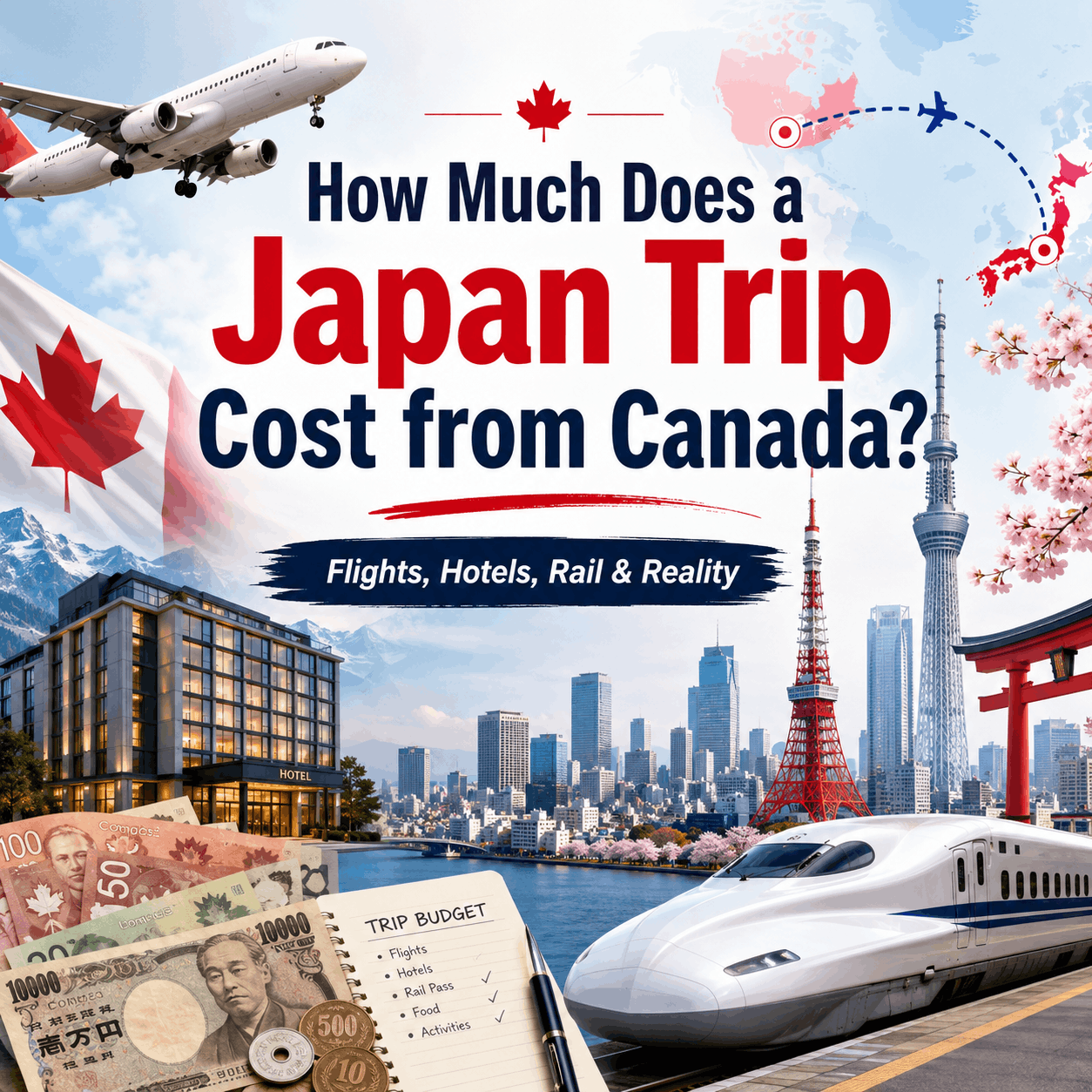
So, how much does a Japan trip from Canada actually cost?
For most Canadians, a realistic Japan trip usually lands somewhere between $3,500 and $6,500 CAD per person for a comfortable 10–14 day trip, including flights.
Can you do it cheaper? Yes.
Can it get way more expensive? Very easily.
Is Japan “cheap”? Not exactly. Japan is one of those places where food and local trains can feel surprisingly affordable, but flights, hotels, long-distance rail, and peak-season timing can quietly punch your budget in the face.
As of July 2026, I would use a simple planning rule: ¥100 is roughly $0.87 CAD, based on recent Bank of Canada exchange-rate data showing the yen around 0.0087 CAD per ¥1.
Quick Japan trip cost estimate from Canada
Here is a realistic planning range for one traveller:
| Travel style | 10–14 day estimated cost |
|---|---|
| Budget traveller | $3,000–$4,200 CAD |
| Mid-range traveller | $4,200–$6,500 CAD |
| Comfortable traveller | $6,500–$9,000+ CAD |
| Luxury traveller | $10,000+ CAD |
For couples or families sharing hotel rooms, the per-person hotel cost can drop, but Japan can still get expensive once you add Shinkansen rides, private tours, theme parks, luggage forwarding, better hotels, and shopping.
1. Flights from Canada to Japan
For Canadians, airfare is usually the first major cost. In 2026, a realistic economy-class planning range is:
| Departure city | Typical economy round-trip planning range |
|---|---|
| Vancouver to Tokyo | $1,100–$1,700 CAD |
| Calgary to Tokyo | $1,200–$1,900 CAD |
| Toronto to Tokyo | $1,300–$2,000 CAD |
| Montreal to Tokyo | $1,300–$2,000 CAD |
From Canada, direct Japan options are strongest from Vancouver, Toronto, Montreal, and Calgary. JNTO Canada lists direct Air Canada flights to Tokyo from Vancouver, Toronto, and Montreal, seasonal Osaka service from Vancouver/Toronto, WestJet seasonal Calgary–Tokyo service, and Vancouver–Tokyo service from JAL, ANA, and ZIPAIR. Flight times are about 9 hours from Vancouver to Tokyo, 10 hours from Calgary, and 13–14 hours from Toronto or Montreal.
Live fare snapshots change constantly, but recent Google Flights results showed Vancouver–Tokyo round trips around CA$1,166 and Toronto/Montreal–Tokyo around CA$1,477 for selected dates, while Air Canada has shown Vancouver–Japan fares from about CAD $1,274.
Flight reality check
The cheapest fare is not always the best fare. A $150 cheaper ticket with a bad layover, airport change, overnight connection, or poor baggage allowance may not be worth it. For Japan, I usually care about three things: total travel time, arrival airport, and how tired you will be on Day 1.
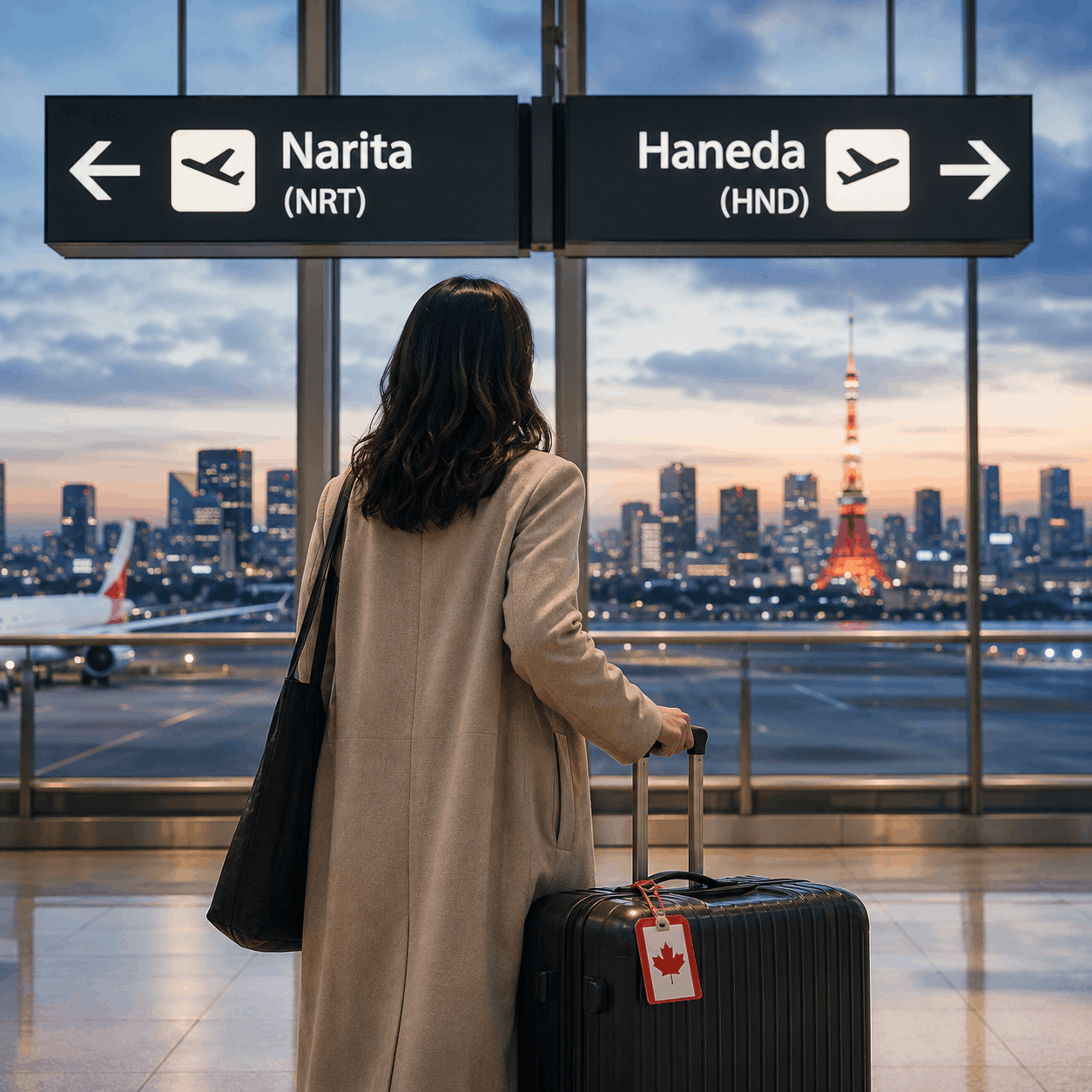
If you are landing in Tokyo and going straight to Kyoto or Osaka, Haneda can be easier than Narita. If you are starting in Osaka/Kyoto, flying into Kansai can save time and money.
2. Hotels in Japan
Hotels are where Japan has changed the most. Japan still has excellent value business hotels, but popular areas like Tokyo, Kyoto, and Osaka are not the bargain they used to be during peak travel dates.
A realistic nightly range:
| Hotel style | Estimated nightly cost |
|---|---|
| Capsule/hostel/budget stay | $35–$90 CAD |
| Business hotel / simple 3-star | $100–$190 CAD |
| Good mid-range hotel | $180–$320 CAD |
| Ryokan or boutique stay | $250–$600+ CAD |
| Luxury hotel | $600+ CAD |
Kyoto is a good example of the new hotel reality. In May 2026, Kyoto’s major hotel sample had an average daily rate of ¥24,231, about $211 CAD, with occupancy at 87%. That ADR excludes consumption and accommodation taxes, so the guest-facing price can be higher.
Hotel reality check
Do not only search “Tokyo hotel.” Tokyo is massive. A cheaper hotel far from the train lines you need can cost you time every single day. A slightly more expensive hotel near a useful station can be the better deal.
Good areas for first-timers usually include Shinjuku, Ueno, Asakusa, Tokyo Station/Ginza, Shibuya, Kyoto Station, Kawaramachi/Gion, Namba, Umeda, and Shin-Osaka depending on the route.
3. Food costs in Japan
Food is one of the better-value parts of Japan. You can eat well without eating fancy.
JNTO Canada notes that even in tourist-heavy areas, a full meal can often be found for around $10 CAD, nicer teishoku meals are often around $10–$15 CAD, and convenience-store items like rice balls, sandwiches, and bento can range from about $1–$5 CAD.
A realistic daily food budget:
| Eating style | Daily food budget |
|---|---|
| Convenience store + casual meals | $25–$40 CAD |
| Normal traveller | $40–$70 CAD |
| Foodie traveller | $80–$150+ CAD |
The beautiful thing about Japan is that “budget food” does not feel miserable. Ramen, udon, curry rice, convenience-store bento, bakery breakfasts, and department-store food halls can all be part of the experience.
Food reality check
The danger is not normal meals. The danger is “little extras”: coffee, vending machines, desserts, late-night snacks, convenience-store experiments, anime café items, wagyu, omakase, cocktail bars, and “just one more thing” shopping.
Japan does not always drain you through one giant expense. Sometimes it drains you through 40 tiny excellent decisions.
4. Rail, Shinkansen, and the Japan Rail Pass
This is where many travellers overpay.
The Japan Rail Pass used to be an automatic recommendation. It is not anymore. You need to compare it against your actual route.
As of the official Japan Rail Pass pricing page, ordinary-car passes bought through the web sales service are:
| Japan Rail Pass | Price in yen | Approx. CAD |
|---|---|---|
| 7 days ordinary | ¥50,000 | ~$435 CAD |
| 14 days ordinary | ¥80,000 | ~$696 CAD |
| 21 days ordinary | ¥100,000 | ~$870 CAD |
For overseas agency purchases, prices increase from October 1, 2026: 7-day ordinary becomes ¥53,000, 14-day ordinary becomes ¥84,000, and 21-day ordinary becomes ¥105,000.
A regular Tokyo–Kyoto Shinkansen ticket is much cheaper than people sometimes assume: about ¥13,320 one-way for a non-reserved seat, or around ¥14,000 for a reserved seat.
That means a simple route like:
Tokyo → Kyoto → Osaka → Tokyo
may not automatically justify a national JR Pass unless you are adding more long-distance travel.
Also note: the Japan Rail Pass can be used on Hikari and Kodama trains, but riding Nozomi or Mizuho requires an extra supplement. For example, Tokyo/Shinagawa to Kyoto has a Nozomi/Mizuho supplement of ¥4,960 with the JR Pass.
Rail reality check
For first-time travellers, the best route is often not “buy JR Pass.” It is:
Plan your cities first.
Check the train cost second.
Buy the rail pass only if the math works.
For many first-timers doing Tokyo, Kyoto, Osaka, and maybe Nara, individual tickets may be easier. For travellers doing Hiroshima, Kanazawa, Hokkaido, Kyushu, or multiple long-distance cities, passes can still make sense.
5. Local transportation
Local transportation in Japan is usually reasonable.
In Tokyo, the Tokyo Metro 24-hour ticket costs ¥700 for adults, while the Tokyo Metro + Toei Subway one-day ticket costs ¥1,100.
A realistic local-transport budget is:
| Trip style | Local transit estimate |
|---|---|
| Light city travel | $6–$10 CAD/day |
| Normal sightseeing | $10–$18 CAD/day |
| Busy city-hopping days | $20–$35 CAD/day |
Airport transfers are extra. For example, the Narita Express round-trip ticket is ¥5,200 for adults, about $45 CAD, and covers round-trip reserved-seat travel between Narita Airport and Tokyo-area stations.
6. Attractions, tours, and experiences
This part depends completely on your travel style.
Temples, shrines, parks, neighbourhood walks, food markets, and city exploration can be very affordable. But theme parks, private guides, anime attractions, tea ceremonies, kimono rentals, TeamLab, sumo experiences, and day tours can add up fast.
A realistic attraction budget:
| Style | Attraction budget |
|---|---|
| Light sightseeing | $150–$300 CAD |
| Normal first-time trip | $300–$700 CAD |
| Theme parks + guided tours | $800–$1,500+ CAD |
For families, attractions can become one of the biggest costs after flights and hotels.
7. Japan tourist tax and small hidden costs
Japan’s International Tourist Tax is now ¥3,000 per departure from Japan, with the National Tax Agency listing the tax rate as ¥3,000 per departure and noting a transition rule for eligible tickets issued on or before June 30, 2026.
This is only about $26 CAD, but it is part of the broader reality: Japan is still good value in many ways, but tourism-related costs are rising.
Other small costs to remember:
eSIM or pocket Wi-Fi
Travel insurance
Luggage forwarding
Coin lockers
Airport transfers
Accommodation taxes
Convenience-store snacks
Souvenirs
Theme park add-ons
Reserved seats during busy periods
Sample Japan trip budgets from Canada
Budget trip: 10 days
A careful traveller staying in simple hotels, eating casually, and limiting long-distance travel might spend:
| Category | Estimate |
|---|---|
| Flights | $1,100–$1,600 |
| Hotels | $700–$1,100 |
| Food | $300–$450 |
| Local transport | $100–$180 |
| Long-distance rail | $150–$300 |
| Attractions | $150–$300 |
| eSIM/insurance/misc. | $100–$250 |
| Total | $2,600–$4,180 CAD |
This is possible, but it requires discipline. Not suffering — discipline. There is a difference.
Mid-range first-time trip: 12 days
A more realistic first-time Japan trip with Tokyo, Kyoto, Osaka, better hotel locations, good food, and a few paid experiences:
| Category | Estimate |
|---|---|
| Flights | $1,300–$1,900 |
| Hotels | $1,500–$2,600 |
| Food | $500–$900 |
| Local transport | $150–$250 |
| Shinkansen / rail | $250–$500 |
| Attractions | $300–$700 |
| eSIM/insurance/misc. | $150–$350 |
| Total | $4,150–$7,200 CAD |
This is the range I would expect for many Canadian travellers who want comfort but not luxury.
Comfortable trip: 14 days
If you want nicer hotels, less rushed routing, some private tours, better meals, luggage forwarding, and maybe a ryokan night:
| Category | Estimate |
|---|---|
| Flights | $1,500–$2,300 |
| Hotels | $2,800–$5,000 |
| Food | $900–$1,800 |
| Transport/rail | $500–$1,000 |
| Attractions/tours | $800–$2,000 |
| Misc. | $300–$700 |
| Total | $6,800–$12,800 CAD |
This is where Japan starts feeling polished instead of merely affordable.
Where Canadians overspend in Japan
The biggest mistakes are usually not obvious.
First, people overbuy rail passes. They hear “JR Pass” and assume it saves money. Sometimes it does. Sometimes it absolutely does not.
Second, people book hotels too late. Japan’s best-value rooms disappear early, especially around cherry blossom season, autumn leaves, Golden Week, summer holidays, and major event dates.
Third, people underestimate luggage. Japan’s train system is fantastic, but dragging large suitcases through train stations is not fun. Luggage forwarding costs extra, but sometimes it is worth every yen.
Fourth, people treat Tokyo, Kyoto, and Osaka like one small triangle. Yes, the trains are fast, but each hotel change still costs time, energy, packing, check-in, check-out, lockers, and mental bandwidth.
So, is Japan expensive for Canadians?
Japan is not cheap in the simple way people imagine. It is not Southeast Asia cheap. It is not “wing it and everything will be fine” cheap.
But Japan is still excellent value when planned properly.
You can eat well without spending much. Public transport is clean and reliable. Hotels are usually efficient. Convenience stores are genuinely useful. Many temples, shrines, streets, gardens, and neighbourhoods give you a huge experience without a huge price tag.
The expensive part is the skeleton of the trip: flights, hotels, long-distance rail, and peak-season timing.
My practical recommendation
For a first Japan trip from Canada, I would usually budget:
$4,500–$6,500 CAD per person for a good 10–14 day trip.
That gives you enough room for decent flights, clean hotels, good locations, Shinkansen travel, food you actually enjoy, and a few special experiences without feeling like you are constantly saying no.
If your budget is closer to $3,000–$4,000, Japan is still possible, but you need to keep the route simple.
If your budget is $7,000+, Japan becomes much more comfortable: better hotel areas, less stress, stronger food choices, and more experiences.
Final reality check
The real question is not just “How much does Japan cost?”
The better question is:
What kind of Japan trip are you trying to have?
Because Japan can be a convenience-store ramen and capsule-hotel adventure.
It can be a clean mid-range Tokyo–Kyoto–Osaka classic.
It can be a luxury ryokan, omakase, private-guide, luggage-forwarding dream.
Same country. Completely different budgets.
For most Canadians, the sweet spot is not the cheapest Japan trip. It is the Japan trip where the route makes sense, the hotels are well located, the train costs are calculated properly, and the schedule gives you room to actually enjoy being there.
That is where Japan becomes worth it.

Comments
0 comments
No comments yet
Be the first to add a thought or question about this article.