
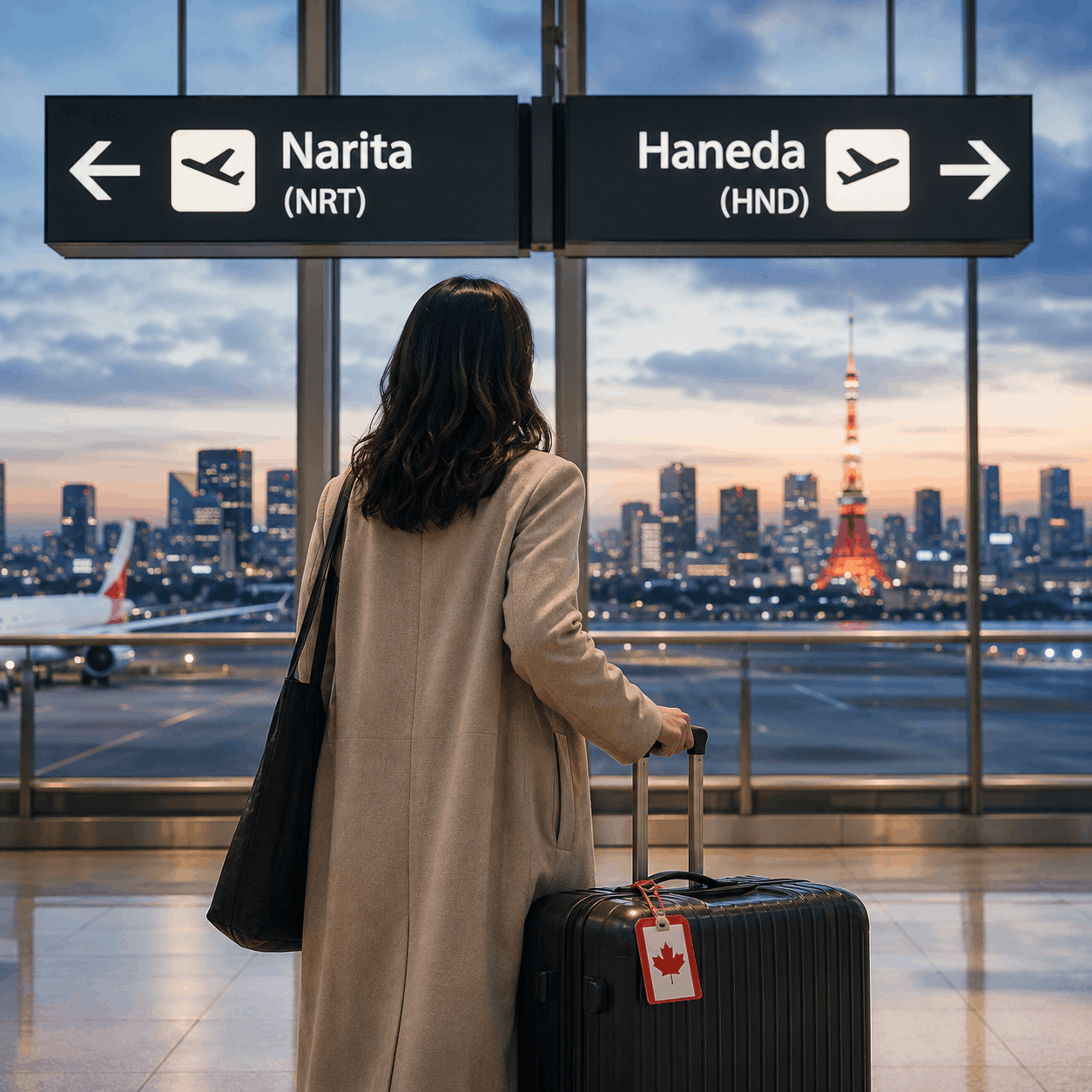
Tokyo has two main international airports: Narita Airport, also known as NRT, and Haneda Airport, also known as HND.
And yes, both are “Tokyo airports.”
In the same way someone from Abbotsford may say they are from Vancouver when explaining things to a foreigner.
Technically true. Spiritually complicated.
So, if you are flying from Canada to Japan, which one should you choose?
The lazy answer is: Haneda is better because it is closer to central Tokyo.
The real answer is: Haneda is usually more convenient, but Narita can absolutely be the smarter choice depending on your fare, airline, arrival time, and hotel location.
Let us break this down properly.
The simple difference
Haneda Airport is closer to central Tokyo.
That is the big one. That is the reason people praise it.
From Haneda, official airport estimates put you around 15 minutes to Shinagawa, 30 minutes to Tokyo Station, 45 minutes to Shibuya, and 50 minutes to Shinjuku by train or monorail, depending on route and timing. So if you land tired, slightly confused, and emotionally damaged by airplane breakfast, Haneda is gentle. It gets you into Tokyo without making you do a side quest immediately.
Narita Airport is farther out.
But Narita is not some wilderness exile where you must befriend raccoons to survive. The Narita Express can reach Tokyo Station in as little as 53 minutes, and the Keisei Skyliner connects Narita with Nippori and Ueno with reserved seating and luggage space.
So the real difference is not “good airport vs bad airport.”
It is more like:
Haneda: easier, closer, cleaner arrival into the city.
Narita: farther, but often very workable, especially if the price or route is better.
For Canadians, your departure city matters a lot
This is where the airport demon starts playing games.
If you are flying from Vancouver, you may see both Haneda and Narita options depending on airline and season. ANA currently promotes daily nonstop Vancouver to Haneda service, plus seasonal Vancouver to Narita service from June 5 to August 31. Air Canada also shows Vancouver to Tokyo/Narita options in its Japan fare listings, though fares and availability change constantly.
If you are flying from Calgary, Narita becomes very relevant because WestJet promotes daily year-round nonstop Calgary to Tokyo service, and its Tokyo route is tied to Narita.
If you are flying from Toronto, Montreal, Ottawa, or Quebec City, you may see either Haneda or Narita depending on the airline, date, fare class, and connection pattern. Air Canada’s current Japan fare examples show routes such as Toronto to Haneda, Toronto to Narita, Montreal to Narita, Montreal to Haneda, Ottawa to Haneda, and Quebec City to Haneda.
Translation: do not marry the airport name before checking the actual itinerary.
I know, tragic.
We all want one heroic answer.
But flight booking is not heroic.
Flight booking is a raccoon with a calculator.
When Haneda is better
Choose Haneda if the price difference is small and your hotel is in places like:
Shinjuku, Shibuya, Ginza, Tokyo Station, Shinagawa, Roppongi, Akasaka, or anywhere central.
Haneda is especially good if:
You are arriving late.
You are travelling with kids.
You have large luggage.
You hate transfers.
You are visiting Tokyo first before going elsewhere in Japan.
You want the least annoying arrival possible.
This is the airport for the person who says, “I just want to land, get to the hotel, shower, and become human again.”
Fair. Deeply fair.
After a Canada-to-Japan flight, nobody wants to stand at a train map pretending they understand it.
You do not understand it.
The map knows.
The map can smell fear.
When Narita is better
Choose Narita if the flight is meaningfully cheaper, more direct, or better timed.
This is especially true if you are flying from Calgary with WestJet, or if Narita gives you a better fare from Vancouver, Toronto, Montreal, or another Canadian city.
Narita also makes sense if you are staying around:
Ueno, Asakusa, Akihabara, Tokyo Station, Ginza, or eastern Tokyo.
Why?
Because the Keisei Skyliner goes toward Nippori and Ueno, and the Narita Express can connect directly to major areas like Tokyo, Shinagawa, Shibuya, Shinjuku, and Yokohama.
Narita is not “bad.”
Narita is just farther.
That is the whole crime.
It did not betray your bloodline.
It simply lives outside the city and asks you to accept consequences.
The real question: how much are you saving?
This is the part most people ignore.
If Haneda is only $50–$100 more per person, I would usually lean Haneda, especially for first-time Japan travellers.
But if Narita is saving you $200–$400 per person, now we have a game.
For a couple, that could be $400–$800 saved.
That is not “airport convenience” money anymore.
That is sushi money.
That is hotel upgrade money.
That is “we accidentally bought too many things at Don Quijote” money.
So yes, Haneda is more convenient.
But convenience has a price.
And sometimes Narita looks at you and says:
“Brother, I am 60–90 minutes away, but I just saved you enough for three excellent dinners.”
Now we listen.
What about arrival time?
Arrival time matters almost as much as the airport.
A Haneda arrival at a horrible hour can be worse than a Narita arrival at a clean, easy time.
For example, I would rather land at Narita in the afternoon with plenty of train options than land at Haneda super late and start worrying about reduced transit, hotel check-in, and taxi costs.
This is especially important for Canadians because Japan flights can already leave your brain slightly scrambled.
Your body thinks it is one time.
Tokyo says, “No, actually, it is tomorrow.”
Your stomach says, “Why was dinner breakfast?”
Nobody is okay.
So when comparing Narita vs Haneda, do not only look at the airport.
Look at:
Arrival time.
Hotel location.
Number of bags.
Train transfers.
Total fare.
Whether the flight is nonstop or connecting.
Whether you are continuing to Osaka, Kyoto, Sapporo, or somewhere else.
That final combination matters more than airport ego.
Be careful with Haneda ↔ Narita airport changes
One thing travellers often miss: sometimes your itinerary may not just involve a plane change.
It may involve an airport change.
That means you land at Haneda, but your next flight leaves from Narita. Or the other way around.
This can happen on some international routes, especially if you are connecting onward to places like India or other parts of Asia. And this is where the “Haneda is closer to Tokyo” argument suddenly becomes less cute.
Because now you are not going into Tokyo.
You are crossing the Tokyo region with luggage, immigration, customs, security, and another flight waiting for you.
Beautiful.
Elegant.
A little cursed.
The two airports are not beside each other. Haneda Airport’s official access page lists the airport shuttle between Haneda and Narita at about 65–85 minutes and ¥3,600, while the train route is listed around 90–115 minutes and ¥1,760–¥3,080, depending on the service. Times and fares can change, so always confirm the schedule before booking.
My practical advice?
Avoid Haneda ↔ Narita airport changes unless the savings are genuinely worth it.
A simple plane change inside the same airport is one thing. An airport change is a whole side quest.
If you must do it, the easiest option for most travellers is usually the Airport Limousine Bus. It is not always the fastest in traffic, but it is direct, luggage-friendly, and mentally easier than dragging bags through train stations while your soul is still somewhere over the Pacific. The official Airport Limousine Bus site also notes online e-ticket booking and airport transport service between Tokyo’s airports.
The train can work too. Keisei’s Access Express route connects Narita with areas like Shinagawa, Shimbashi, and Nihombashi, and onward Haneda access is part of the larger Keisei/Toei/Keikyu through-service world. It can be cheaper, but it is more annoying with heavy luggage or family travel.
So the rule is simple:
Do not book an airport-change connection unless you have a comfortable buffer.
I would want at least 5 hours minimum, and honestly 6–7 hours feels safer, especially if you are arriving internationally, clearing immigration, collecting bags, moving airports, checking in again, and going through security.
Because a 3-hour airport change may look okay on paper.
Paper is a liar.
Paper has never stood at baggage claim wondering why suitcase number 47 is someone’s neon-green golf bag.
Best way to handle a Haneda ↔ Narita transfer
If your itinerary requires changing airports, do this:
First, check whether your bags are checked through to the final destination. If not, you need extra time.
Second, check the actual arrival and departure terminals.
Third, use the Airport Limousine Bus if you want the simplest transfer. Buy the ticket at the airport counter or online, load your luggage, sit down, and let the bus do the suffering.
Fourth, use the train only if you are comfortable navigating Japanese transit with luggage. It can save money, but it asks for more attention.
Fifth, avoid taxis unless money has personally offended you. A taxi between Narita and Haneda can be very expensive because the airports are far apart.
And most importantly:
If you see an itinerary with a Haneda-to-Narita transfer and a short connection, treat it with suspicion.
Not fear.
Suspicion.
Like it is smiling too politely.
My honest recommendation for Canadians
If the price is close, choose Haneda.
Simple.
It is closer, smoother, and easier for most first-time Tokyo arrivals.
But if Narita gives you a better nonstop flight, better timing, or a much cheaper fare, do not reject it just because travel blogs keep worshipping Haneda like it descended from Mount Fuji holding a Suica card.
Narita is fine.
Narita works.
Narita has trains, luggage space, airport buses, and thousands of travellers using it every day without turning into tragic anime protagonists.
For first-timers, my personal rule would be:
Pick Haneda if the fare difference is small. Pick Narita if the savings are real or the route is cleaner.
That is the whole thing.
Not glamorous.
But useful.
And useful is what you want when you are dragging luggage through Tokyo after flying from Canada.
My Thoughts
For most Canadians flying into Tokyo, Haneda is the better airport if convenience is your priority.
But Narita can be the better choice if it gives you a cheaper fare, a nonstop route, better schedule, or easier connection from your Canadian city.
Do not choose based on airport name alone.
Choose based on the full journey.
Because the best Tokyo airport is not the one with the better reputation.
It is the one that gets you from Canada to your hotel with the least pain, the least wasted money, and the lowest chance of standing in a station at 9:47 PM whispering:
“Why are there twelve exits?”


Comments
0 comments
No comments yet
Be the first to add a thought or question about this article.