
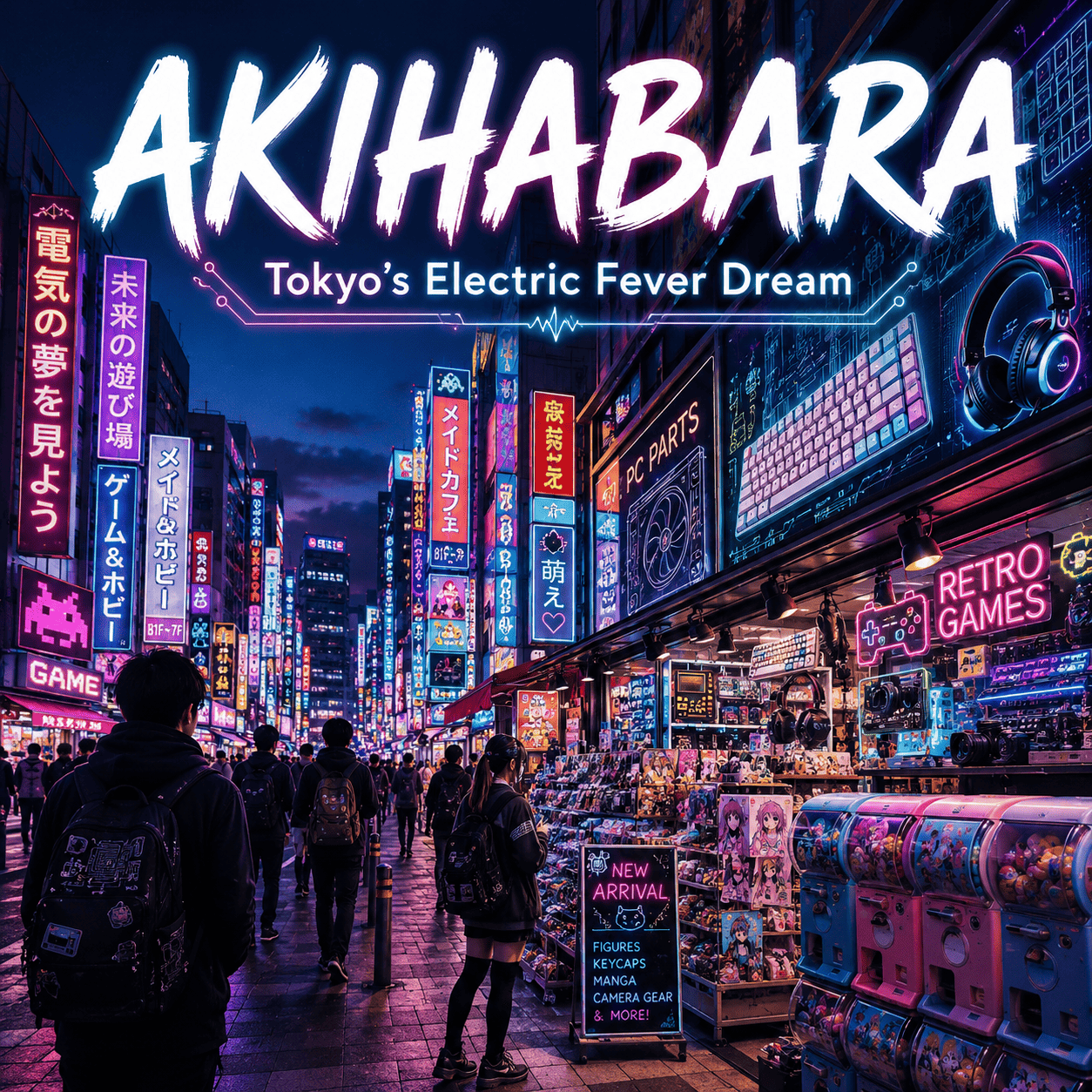
Akihabara is not subtle.
Some neighborhoods whisper. Akihabara plugs a guitar amp into the moon and starts screaming in 8-bit.
This is Tokyo’s electric fever dream: anime banners hanging from buildings, towers of manga, retro games hiding in small stairwells, PC parts glowing like forbidden relics, idol music drifting from somewhere, and at least one person dressed like they accidentally escaped a side quest.
Officially, Akihabara is known for electronics, anime, manga, games, figures, and computer parts, especially around Chuo-dori and the side streets of Electric Town.
Spiritually, Akihabara is what happens when a motherboard, a manga shelf, a gacha machine, and a sleep-deprived otaku all achieve fusion.
It is not “traditional Japan” in the postcard sense.
It is not temples, tatami, matcha, and the sound of a bamboo fountain going donk.
Akihabara is different.
Akihabara is Japan’s inner nerd cave made public.
And if you are into anime, gaming, electronics, figures, PC builds, retro consoles, cameras, keyboards, headphones, model kits, trading cards, or simply watching human obsession become urban planning, then yes — you should go.
What Akihabara Is Actually Like
Akihabara, often called Akiba, sits in central Tokyo and has long been known as Electric Town. It started as a major electronics district, then evolved into one of the world’s most recognizable hubs for anime, manga, gaming, and otaku culture.
The important thing to understand is this:
Akihabara is not one attraction.
It is a density field.
You do not “see Akihabara” the way you see a temple. You enter it, get mildly overwhelmed, follow a random sign, climb three floors, find a store selling a figure from an anime you watched twelve years ago, then suddenly question your budget, your suitcase space, and the moral architecture of capitalism.
This is normal.
Akihabara does not attack you.
It merely presents options until your brain becomes a browser with 74 tabs open.
Who Should Visit Akihabara?
Akihabara is especially worth visiting if you are:
A first-time Tokyo visitor who grew up watching anime and wants to see the mothership.
A gamer who still gets emotional seeing old consoles, cartridges, arcades, rhythm games, fighting game cabinets, or retro box art.
A tech enthusiast who hears “multi-floor electronics store” and immediately starts walking faster.
A figure collector, Gunpla builder, manga reader, keyboard nerd, camera person, headphone goblin, PC builder, or someone whose idea of romance is finding a rare item in a glass display case.
A normal tourist travelling with one of the above people and wondering why they have suddenly become possessed.
Akihabara is for the person who sees a giant anime billboard and thinks, “Yes. Civilization has peaked.”
Best Things to Do in Akihabara
1. Walk Chuo-dori and Let the Neon Download Into Your Brain
Start with Chuo-dori, the main street. This is where the district announces itself loudly: big signs, large stores, anime advertisements, electronics shops, and crowds moving with the strange ritualistic rhythm of people hunting for very specific goods.
This is the “yes, I am in Akihabara” moment.
Do not rush it.
Look up. Look sideways. Look into alleys. Akihabara rewards curiosity. The main road gives you the obvious spectacle, but the side streets are where the real dungeon entrances appear: smaller electronics shops, second-hand stores, retro game places, niche collectibles, and stores that feel like they were designed by someone who said, “What if we made a warehouse, but for obsession?” Tokyo’s official tourism guide specifically points out that the side alleys near the main road are full of niche shops for retro games, computer parts, and dedicated fans.
Akihabara is basically an RPG town where every staircase might lead to a secret vendor.
2. Visit Radio Kaikan, the Great Tower of “Oh No, I Want That”
Radio Kaikan is one of Akihabara’s classic landmarks, with many stores inside selling anime goods, figures, hobby items, and collectibles. Japan Guide notes it as one of the area’s iconic landmarks, with over 30 stores.
This is a good first stop because it compresses the Akihabara experience into one building.
You enter thinking, “I’ll just browse.”
Famous last words.
Inside, you may find figures, model kits, character goods, trading cards, plushies, and merchandise from series you thought you had emotionally outgrown.
You had not.
You merely placed them in storage.
Radio Kaikan will find them.
This is where your inner 14-year-old and your adult credit card may begin negotiating like hostile nations.
3. Explore the Anime and Figure Shops
Akihabara is one of the best places in Tokyo to shop for anime goods, manga, figures, character merch, and collectibles. The neighborhood is widely associated with manga and anime culture, alongside its electronics roots.
The trick is not to buy the first thing you see.
Akihabara has layers.
A figure that looks rare in one store may appear again two streets later for a different price. Some shops specialize in new goods, others in pre-owned items, some in prize figures, some in premium scale figures, some in trading cards, some in “I did not know this franchise had this much merchandise, but apparently the economy is alive.”
For anime fans, this is not just shopping.
This is archaeology.
You are digging through the sediment of your own memory.
Naruto. Evangelion. One Piece. Gundam. Fate. Hololive. Love Live. Dragon Ball. Demon Slayer. Jujutsu Kaisen. Random seasonal anime from 2016 that somehow still has one acrylic stand left, waiting for you like a cursed relic.
Akihabara does not care whether a series is mainstream, obscure, ancient, or emotionally dangerous.
It simply says:
“Here. Look what still exists.”
4. Go Retro Game Hunting
For gamers, Akihabara is dangerous in the best way.
There are stores selling retro games, consoles, controllers, cartridges, handhelds, and old gaming hardware. The official Tokyo guide notes that Akihabara’s side streets include specialty shops for retro games and computer parts.
This is where the tech enthusiast becomes a pilgrim.
You may see old Famicom games, Game Boy cartridges, PlayStation titles, Dreamcast things, weird peripherals, boxed games, loose games, Japanese-only games, rhythm game controllers, and items that make you say:
“I do not need this.”
Then your soul replies:
“But look at it.”
Retro gaming in Akihabara feels different because it is not just nostalgia. It is physical proof that your childhood was not imaginary. The consoles are there. The cartridges are there. The plastic has yellowed. The boxes are slightly damaged. The pixels remain immortal.
This is not shopping.
This is necromancy with HDMI cables.
5. Visit an Electronics Megastore
Akihabara’s electronics side is still alive. Big stores and smaller specialty shops sell cameras, headphones, PC parts, gadgets, keyboards, appliances, gaming accessories, and tech tools. Akihabara’s identity as Electric Town remains central to the area, even as anime and gaming culture have become more visible.
This is where the tech enthusiast starts speaking in specs.
Refresh rate. Sensor size. Switch type. Noise cancellation. GPU compatibility. Voltage. Tax-free. Warranty. Adapter. Import model. International model.
To everyone else, it sounds like wizard language.
To the tech person, it is prayer.
Akihabara is excellent for browsing, comparing, and seeing Japan’s consumer tech culture up close. Just be careful with expensive purchases. Check whether the item has English settings, international voltage compatibility, warranty coverage outside Japan, and whether the price is actually better than back home.
Because nothing says “side quest failed” like buying a beautiful gadget that becomes a decorative brick in Canada.
6. Try a Maid Cafe, But Know What You Are Signing Up For
Maid cafes are one of Akihabara’s most famous subculture experiences. At-home Cafe, one of the well-known maid cafe brands, describes itself around the “moe moe kyun” experience and runs multiple cafe locations.
Now, important.
A maid cafe is not just a cafe.
It is theatre.
You are paying for a performance: cute greetings, themed language, playful rituals, decorated food, maybe a song or chant, and a level of cheerful energy that may make introverts feel like they accidentally walked into an anime opening.
For some visitors, it is hilarious and fun.
For others, it is sensory combat.
Go in with the correct expectation: you are not there for the best coffee of your life. You are there because Akihabara has invited you into one of its strange little pocket dimensions.
Respect the staff. Follow the rules. Do not be weird.
Akihabara is already weird enough. It does not need your help.
7. Play Arcades and Gacha Machines
Akihabara is still a strong place for arcade-style entertainment, crane games, rhythm games, gachapon, and game centers. Even if you are not a hardcore arcade person, it is worth walking in just to feel the soundscape.
Buttons. Music. Coins. Screens. Lights. Mild despair.
The crane machines are especially dangerous because they do not attack your wallet directly.
They seduce it.
“One try.”
Then another.
Then another.
Then you realize you have spent enough money to buy the prize directly, but now it is about dignity.
This is how the machine wins.
The machine does not want your money.
It wants your ego.
A Simple Akihabara Route for First-Timers
Here is the clean version.
Start at Akihabara Station, ideally using the Electric Town Exit, which is commonly recommended for reaching the heart of the area.
Walk toward Chuo-dori.
Browse the big shops first to orient yourself.
Visit Radio Kaikan for anime goods and figures.
Dip into the side streets for retro games, electronics, PC parts, and smaller specialty stores.
Take a break in a cafe or food spot.
Try a maid cafe or arcade only if it actually sounds fun to you.
End with one final walk through the neon after sunset.
Akihabara is better at night.
Not because daytime is bad, but because night lets the district reveal its final form.
In daylight, Akihabara is a shopping district.
At night, Akihabara becomes a cyberpunk vending machine with anime trauma.
How Long Should You Spend in Akihabara?
For casual visitors: 2–3 hours.
For anime fans: half a day.
For gamers, collectors, PC builders, camera nerds, keyboard people, and anyone who has ever said “I’ll just quickly check one more store”: you are not leaving. Tell your family you loved them.
Realistically, Akihabara can be paired with nearby areas like Ueno, Kanda, or Asakusa depending on your route, but if you are deeply into anime or tech, do not squeeze it into a tiny time slot.
Akihabara punishes arrogance.
You think one hour is enough.
Then you blink and realize you have spent 45 minutes comparing two versions of the same character figure because one has a slightly better facial expression.
What to Buy in Akihabara
Good Akihabara purchases include:
Anime figures, especially if you compare prices first.
Manga and art books, though many will be in Japanese.
Retro games and consoles, with region compatibility in mind.
Gunpla and model kits.
Trading cards and collectible goods.
Headphones, cameras, keyboards, PC parts, and gadgets.
Gachapon, because tiny plastic nonsense is sometimes the purest form of joy.
The important rule: do not buy heavy things early in the day unless you are emotionally prepared to carry your own consequences.
A big figure box looks cute in the store.
After three hours, it becomes a cursed cube.
Akihabara Travel Tips
Bring your passport if you plan to do tax-free shopping. Many larger stores in Japan require it for tax-free purchases.
Compare prices before buying expensive electronics or premium collectibles.
Check voltage, warranty, language settings, and compatibility for electronics.
Bring cash for smaller stores, gachapon, arcades, and random purchases.
Do not photograph people, staff, or cosplayers without permission.
Do not assume every anime shop has English support. Pointing, translation apps, and humility remain undefeated.
Leave suitcase space.
No, more than that.
Akihabara purchases reproduce when unsupervised.
Common Mistakes First-Timers Make
Mistake 1: Thinking Akihabara Is Only for Anime Fans
Anime is a huge part of Akihabara, but the area is also excellent for electronics, gaming, cameras, PC parts, audio equipment, keyboards, retro hardware, and gadget browsing. Its Electric Town identity still matters.
Akihabara is not just “anime town.”
It is obsession town.
Anime is simply the loudest resident.
Mistake 2: Buying Too Quickly
Do not panic-buy the first figure, game, or gadget you see.
Akihabara has repetition. You may find the same item again. Sometimes cheaper. Sometimes in better condition. Sometimes in a store that feels like it should require a secret password but is actually just up a narrow staircase.
Mistake 3: Going When You Are Already Tired
Akihabara is stimulation-heavy. If you are jet-lagged, hungry, overheated, or emotionally fragile, Akihabara will turn your brain into fried yakisoba.
Eat first.
Hydrate.
Then enter the neon battlefield.
Mistake 4: Forgetting That Akihabara Is Still a Real Neighborhood
It is easy to treat Akihabara like an anime theme park, but it is still a real Tokyo district with workers, residents, shops, rules, and etiquette.
Be curious, not obnoxious.
Enjoy the spectacle without becoming the spectacle.
Is Akihabara Worth Visiting?
Yes, but with the right expectation.
Akihabara is not the “most beautiful” part of Tokyo.
It is not serene.
It is not elegant.
It is not quiet luxury.
It is loud, commercial, crowded, nerdy, excessive, and occasionally absurd.
But that is the point.
Akihabara is where Japan’s love of craft, collection, fandom, technology, play, performance, miniaturization, specialization, and niche obsession all collide in one district.
It is the place where someone looked at modern life and said:
“What if the city itself had a hobby?”
And somehow, the answer became Akihabara.
Best For
Anime fans
Gamers
Tech enthusiasts
Figure collectors
Retro game hunters
PC builders
Gadget shoppers
People who enjoy strange cultural density
Travellers who want Tokyo’s pop-culture side
Anyone who has ever said, “I don’t need it, but I need to see it”
Not Best For
Travellers who hate crowds
People who dislike shopping districts
Travellers looking only for temples and traditional scenery
Anyone already overstimulated from Tokyo
People with no interest in anime, games, tech, or pop culture
Minimalists travelling with one small backpack and a fragile sense of discipline
Akihabara will test that discipline.
Akihabara has defeated stronger monks than you.


Comments
0 comments
No comments yet
Be the first to add a thought or question about this article.