
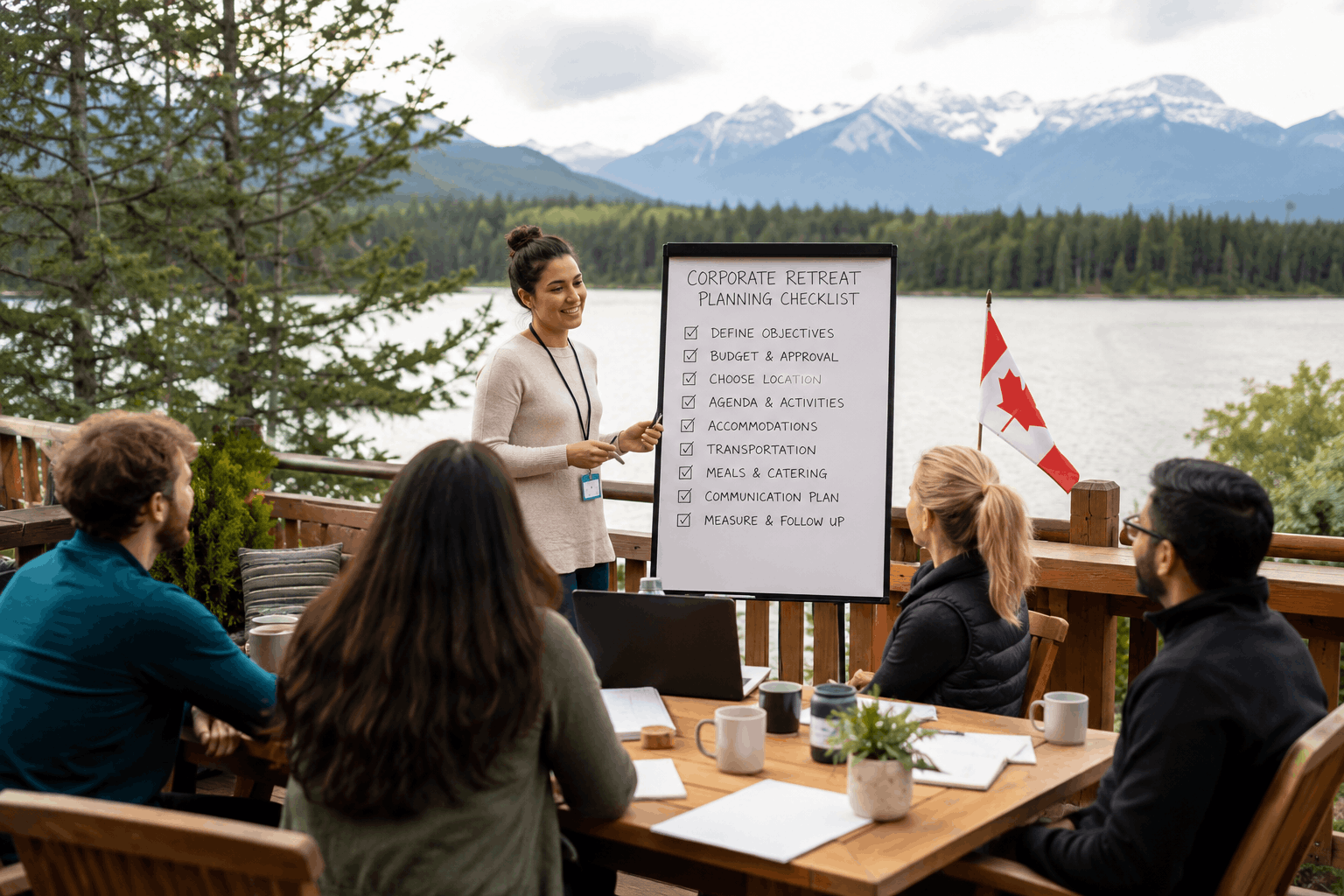
The idea is simple: bring the team somewhere, step back, reconnect. The execution is where things get complicated. This guide is for companies that want to get the planning right before the calendar invites go out.
It always starts the same way. Someone says, "We should do a retreat this year." The room nods. It sounds easy.
Then the questions start. Who's invited? Are spouses welcome? Do we fly everyone together? Who shares rooms? What happens to the person whose passport expires in three months? Who owns the dietary list? What does the accountant say about the taxable-benefit question?
A corporate retreat is a project. It involves logistics, contracts, budgets, compliance considerations, and a group of people who all have different needs, schedules, and expectations. The companies that do retreats well aren't necessarily the ones with the biggest budgets. They're the ones who made the decisions early, assigned ownership clearly, and left enough room for the trip to actually feel human.
This guide is built for Canadian companies planning a retreat, incentive trip, offsite, or leadership gathering — whether that's a weekend in Whistler or a week in the Yucatán. Work through it before you start collecting quotes and signing contracts. It'll save you from making expensive decisions in the wrong order.
Part One
Before you pick a destination, define what this trip is actually for
The most common mistake in retreat planning is jumping to the fun part — the resort, the city, the activities — before settling the foundational question: what is the business reason for this trip?
A corporate retreat, an incentive trip, a leadership offsite, and a team celebration can all look similar from the outside. They're not. Each one needs different budget logic, different agenda structures, different attendance rules, and in some cases different tax treatment. Calling a reward trip a "retreat" because it sounds better creates confusion that compounds over every subsequent planning decision.
"The first planning question is not 'Where should we go?' It's 'What are we trying to accomplish, and what does success look like after everyone flies home?'"
A corporate retreat is typically built around alignment, culture, planning, and internal reset. An incentive trip is a reward for performance — it should feel celebratory, not like a working session in nicer surroundings. A leadership offsite is smaller, more private, and more focused on decision-making. A workation-style trip may blend flexible work sessions with destination experience, but it still needs structure.
The purpose shapes everything else. It determines your budget, which destinations make sense, how much agenda programming you need, and how to frame the trip internally so employees understand what they're being invited to.
Before requesting any quotes, define:
- Main purpose of the trip
- Required business sessions
- Optional leisure or social components
- Whether attendance is mandatory or optional
- Whether this is for employees only, employees plus guests, clients, partners, or a mix
- Whether the trip is a reward, training event, planning session, conference, retreat, or celebration
- What success looks like after the trip
Part Two
Assign an owner, build a budget, and lock the guest list — in that order
These three steps belong together because each one depends on the last. Without a clear owner, budget decisions stall. Without a budget, you can't meaningfully shortlist destinations. Without a guest list, you don't have a real budget.
Ownership. Every corporate retreat needs one clear internal owner. This doesn't mean one person manages every detail — it means one person (or a small committee) has final authority on decisions, approvals, deadlines, and communication. Without it, planning becomes a game of competing suggestions. Finance wants the cheapest option. The CEO has a "vibe" in mind. HR has concerns. Employees start emailing the wrong people. The person with the most opinions starts driving decisions by default.
For smaller companies, the owner is often the founder, operations lead, executive assistant, or HR lead. For larger organizations, a small project committee works well — as long as someone has final say.
Assign clear ownership for:
- Budget approval
- Destination approval
- Travel advisor and vendor communication
- Employee communication
- Rooming list and flight preference collection
- Travel document reminders
- Meeting agenda
- On-site leadership
- Emergency contact plan
- Final sign-off
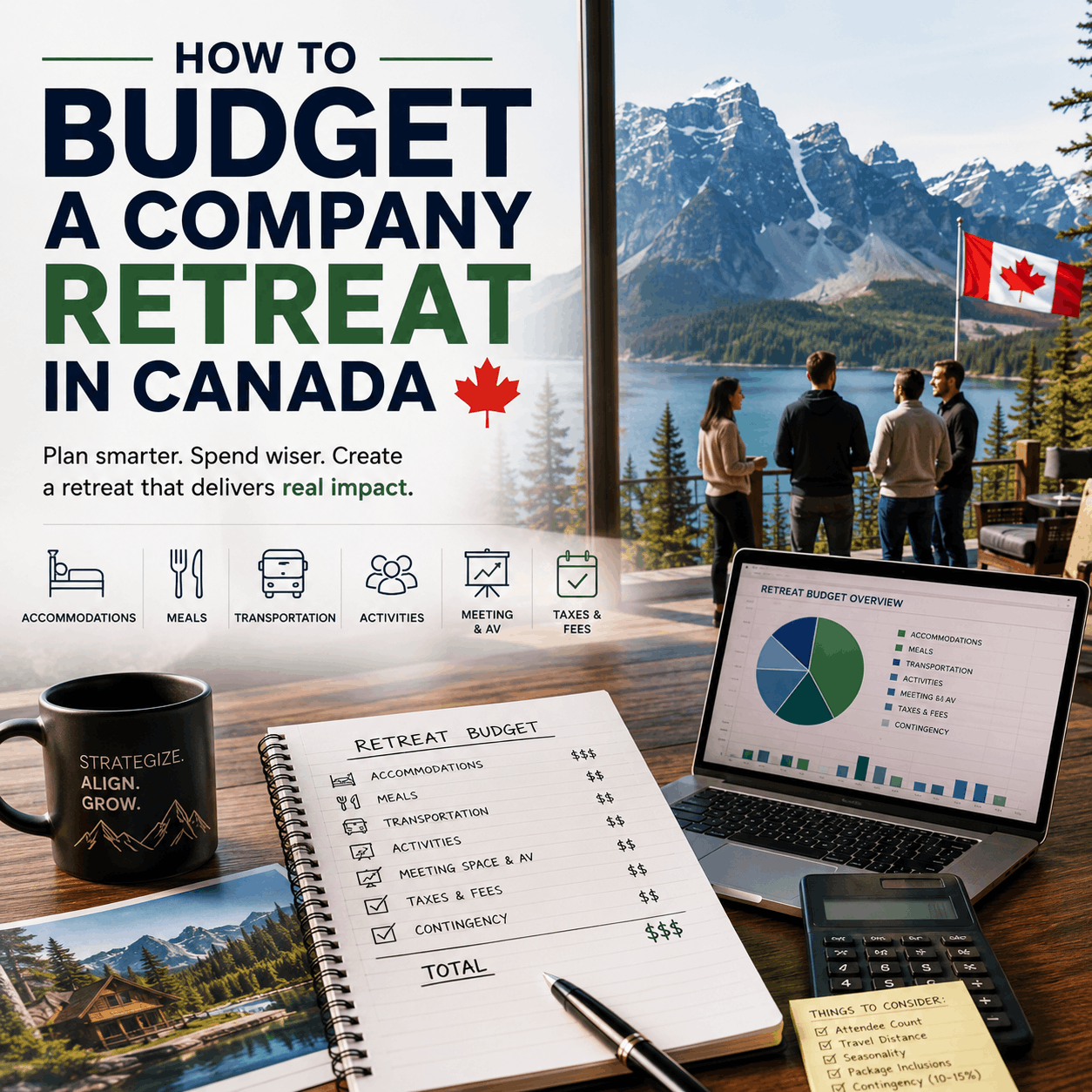
Budget. Build the budget before you choose a destination. This sounds obvious and is consistently ignored. Companies spend weeks comparing resorts that were never actually within range. The visible price — the per-night room rate — rarely captures the full picture. Add flights, baggage, meeting rooms, AV support, transfers, meals, group dinners, activities, taxes, resort fees, single occupancy supplements, travel insurance, and a buffer for changes and emergencies.
For Canadian companies, it's also worth involving your accountant early. The CRA notes that employers may need to include the value of a benefit or allowance in an employee's income depending on the type of benefit and the reason it was provided — which matters when the trip includes a reward component, personal extensions, or guest travel.
Budget decisions to make before requesting quotes:
- Total company budget and per-person budget
- Whether the company pays 100% or employees contribute
- Whether airfare is included
- Whether guests or spouses are included — and who pays
- Whether employees can upgrade at personal cost
- Whether personal extensions are permitted
- Whether travel insurance is required or optional
- Who approves over-budget requests
The guest list. The roster is not just a names sheet — it drives every line in your budget. You need to know how many people are travelling, how many rooms you need, how many are flying from each city, who needs single occupancy, who has accessibility or dietary requirements, and whether any guest or partner arrangements apply.
In Canada, organizations collecting employee travel information should be aware of their privacy obligations. PIPEDA applies to private-sector organizations across the country during commercial activity, and the Office of the Privacy Commissioner provides guidance on how personal information should be handled. Collect only what you actually need, store it securely, and handle it with respect.
For each traveller, collect:
- Full legal name as shown on passport or ID
- Preferred name
- Date of birth (only if required for booking)
- Departure city
- Room preference
- Accessibility needs
- Dietary requirements
- Emergency contact
- Travel document status
- Loyalty program numbers, if relevant
- Extension requests
- Approval status
Part Three
Choosing where and when — with both eyes open
The destination conversation usually starts too early and without enough constraints. A genuinely good retreat destination isn't just a beautiful place — it's a place that works operationally for your specific group, timing, and purpose.
Consider flight access from your team's actual cities, not just head office. Think about whether there's meeting space that matches your needs, internet reliability if work sessions are involved, dietary flexibility, and transfer time from the airport. A resort that looks stunning in photos can add two hours each way in ground transport — which matters when you're coordinating a group.
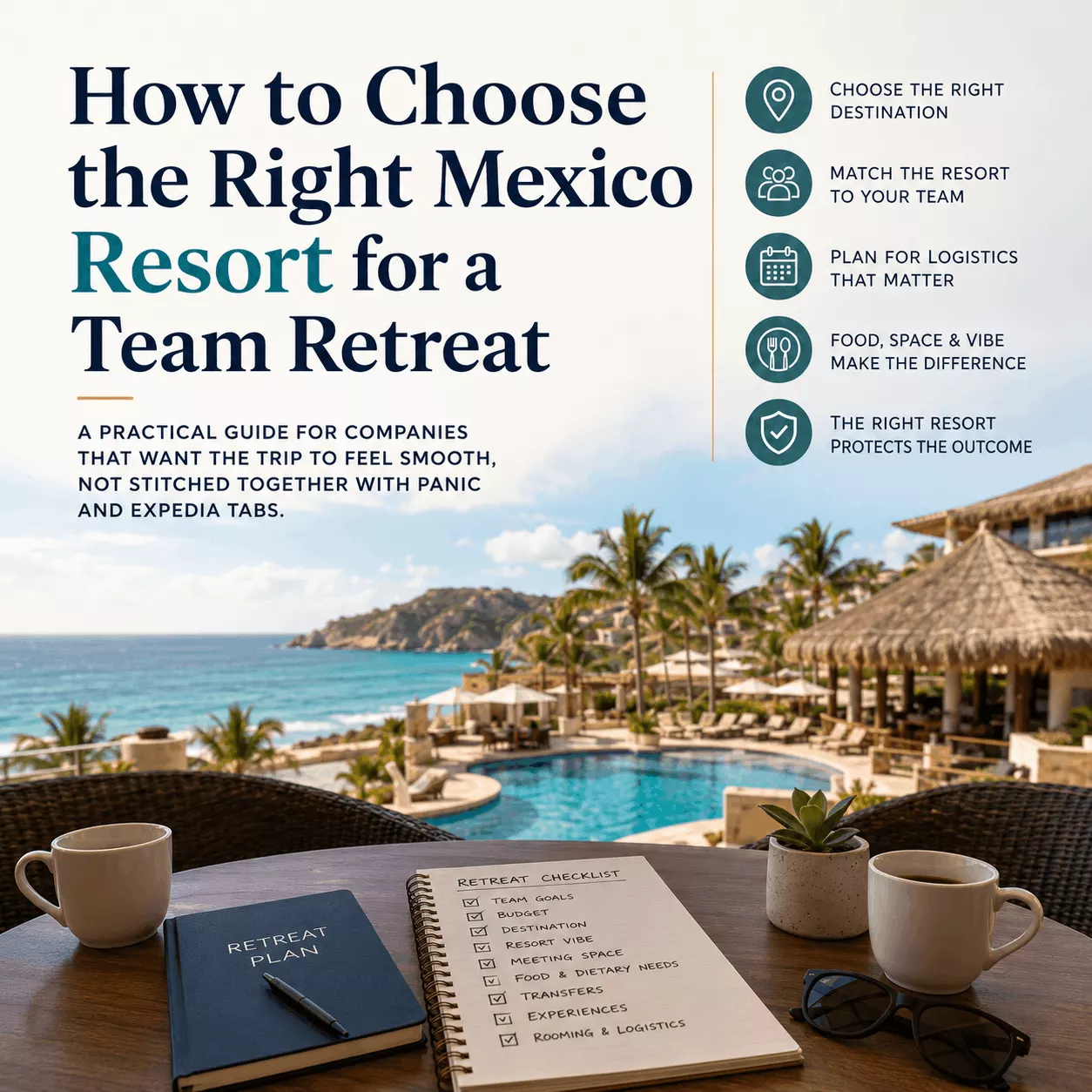
For Canadian companies, the options range from local retreats (Whistler, Kelowna, Banff, Mont-Tremblant, Niagara) to sun destinations (Mexico, Dominican Republic, Costa Rica) to urban offsites in cities like Vancouver, Toronto, or Montreal. Each has a different cost structure, logistical complexity, and atmosphere.
For international travel, the Government of Canada's Travel Advice and Advisories are the official reference for destination safety information — check them before committing, and check them again closer to departure, because conditions change.
When evaluating destinations, ask:
- Can most people reach it with reasonable flights from their home city?
- Are there direct or one-stop options from key Canadian cities?
- Is the destination appropriate for the season?
- Are passport and visa rules manageable for all travellers?
- Is the Government of Canada's travel advisory acceptable?
- Does the destination match the tone of the retreat?
- Are transfers from the airport simple?
- Is there adequate meeting space?
- Is there enough room inventory for your group?
- Can dietary and accessibility needs be handled?
Dates. Don't pick dates based on low season pricing alone. Cheap dates may land during quarter-end crunch, school breaks, statutory holidays, or the height of Caribbean hurricane season. Check leadership availability first, then look at the business calendar for blackout periods. Offer two or three date ranges before committing to one — it creates flexibility and surfaces conflicts early.
Flights. Group flight logistics are where retreats often start to wobble. You may have people departing from Vancouver, Calgary, Toronto, Edmonton, and Montreal — all with different direct-flight options, baggage expectations, and schedule constraints. The goal isn't always the cheapest fare. The goal is a clean, manageable operational plan that minimizes confusion on travel day.
Prepare for disruptions. The Canadian Transportation Agency explains that airline obligations for delays and cancellations depend on the airline and whether the disruption is within their control — but it's the company's job to have a process ready, not to discover it mid-trip.
For flights, confirm:
- Departure cities for all travellers
- Direct-flight preferences and maximum acceptable layover time
- Whether U.S. connections are acceptable
- Arrival window and whether everyone must arrive together
- Whether executives need different flight times
- Baggage inclusion and seat selection expectations
- Name accuracy and passport-name matching
- Change flexibility, group ticket rules, and cancellation terms
- Payment deadline
Part Four
The hotel, the agenda, and the food — details that make or break the experience
A five-star property can still be the wrong choice. A romantic couples resort feels awkward for a team offsite. A party hotel isn't right for a strategy session. A boutique property with no meeting space defeats the purpose. When evaluating properties, the questions that matter most aren't about star ratings — they're about whether the place can actually support what you need to do.
For all-inclusive resorts, dig deeper than the base rate. Ask whether group dinners can be reserved at à la carte restaurants, whether meeting space is included or extra, whether private events are possible, and whether the beach and common areas are suitable for your group's demographic. What looks like a deal can become expensive once you add the things your team actually needs.
Evaluate each property on:
- Room inventory, categories, and single occupancy costs
- Twin-bed availability
- Meeting room capacity and breakout rooms
- Wi-Fi quality and AV support
- Private dining options and dietary flexibility
- Accessibility, noise level, and resort layout
- Distance from airport and transfer simplicity
- Cancellation and group contract terms
- On-site support and fit for company culture
The agenda. The single biggest mistake companies make is overpacking the retreat schedule. People are travelling, adjusting time zones, socializing in ways that take energy, and absorbing more stimulation than a normal workday. A wall-to-wall agenda produces an exhausted team, not a recharged one.
Build the schedule around a simple principle: enough structure that people know what to expect, enough space that they can actually breathe. One or two focused work blocks per day. Shared meals. Real downtime. Optional activities. Leadership that's visibly present and available, not always presenting.
Sample 3-day rhythm
Day 1
Arrival and reset
Arrivals, check-in, optional settle-in time. Welcome dinner with light opening remarks. No working sessions. Let people land.
Day 2
The main day
Morning strategy or planning session. Shared lunch. Afternoon breakout or team activity. Genuine free time. Group dinner — relaxed, not programmed.
Day 3
Reflection and close
Short closing session: key takeaways, next steps, what happens when we're back. Departures.
For the agenda:
- Define mandatory sessions and optional sessions separately
- Avoid early sessions after late arrivals
- Leave buffers between activities
- Include real downtime, not just "free time" that's subtly scheduled
- Avoid alcohol-centred programming as the main bonding mechanism
- Create alternatives for people who opt out of intense activities
- Confirm meeting room setup, AV needs, and meal timing
- Confirm speaker or facilitator requirements if applicable
Food and dietary needs. Food is not a small detail. It affects inclusion, energy, and how welcome people feel. Vegetarian, vegan, halal, kosher, gluten-free, nut-free, dairy-free, and allergy-related dietary requirements should be collected before departure and communicated to the property in advance — not figured out at the buffet.
For international travel, the Government of Canada also provides destination-specific health information including food and water precautions, which is worth reviewing before finalising a venue.
Collect in advance:
- Dietary restrictions and allergies
- Religious dietary requirements
- Vegetarian and vegan needs
- No-alcohol preferences
- Severe allergy notes that require kitchen notification
- Private group dining needs and meal timing preferences
Part Five
The logistics that protect people — documents, insurance, rooming, and safety
This is the section most companies under-plan. The work isn't glamorous, but problems here — a passport that's expiring, an uninsured emergency, a rooming arrangement nobody consented to — can turn a good trip into a bad one very quickly.
Rooming. Don't assume employees are comfortable sharing rooms to reduce costs. Don't casually pair people without consent. Build the rooming list with privacy, seniority, and individual comfort in mind, and communicate the policy clearly before people start wondering. Decide early whether shared rooms are voluntary or assigned, whether employees can pay to upgrade to single occupancy, and whether guests or partners are permitted and under what terms.
Rooming decisions to make early:
- Single vs. shared room policy
- Who qualifies for single rooms
- Whether executives get separate room categories
- Whether employees can pay to upgrade
- Whether guests or spouses are permitted
- Whether room sharing is voluntary or assigned
- Whether gender, privacy, or accessibility considerations apply
- Deadline for final rooming list
Travel documents. For international travel, document issues can derail a trip entirely. Some employees may not have a valid passport. Some passports may be expiring sooner than the destination requires. Some employees may hold non-Canadian passports and need different visa arrangements. Some may be permanent residents with additional documentation needs. Start the document check earlier than feels necessary — passport renewals take time.
The Government of Canada advises checking entry and exit requirements for each destination, and notes that many countries require a passport to be valid for a period beyond the traveller's planned departure date.
For every traveller, confirm:
- Legal name matches travel document
- Passport validity and blank pages if required
- Visa or eTA requirements
- Permanent resident card needs
- Transit visa requirements (including U.S. connections)
- Destination entry requirements
- Return-to-Canada document requirements
- Passport renewal timeline for anyone close to expiry
Travel insurance. Canadian provincial health coverage does not travel with you. The Government of Canada is direct about this: health insurance is almost certainly not valid outside Canada, provincial plans may cover little or nothing abroad, and the Government of Canada will not pay your medical bills overseas. For a company sending a group internationally, insurance is not optional.
Decide whether the company will provide group coverage, require employees to purchase their own, or some combination. Also clarify what's covered for guests, for personal trip extensions, and for activities — particularly adventure activities that standard policies often exclude.
The Government of Canada also notes that many policies won't cover travel to destinations under a "Avoid non-essential travel" or "Avoid all travel" advisory — which is another reason to check advisories before booking, not after.
Insurance coverage to review:
- Emergency medical coverage
- Trip cancellation and interruption
- Baggage delay and loss
- Pre-existing condition rules
- Adventure and activity exclusions
- Coverage under active travel advisories
- Coverage for personal extensions
- Coverage for guests or spouses
- Whether employer policies or credit cards provide any baseline coverage
Safety and emergency planning. A group company trip is organized travel, which means safety planning is part of the job. This doesn't need to be elaborate — it needs to be practical and ready before you leave.
The Canadian Centre for Occupational Health and Safety provides guidance on travel-related health and safety for workers. For international trips, Canadians can register with Registration of Canadians Abroad — a free Government of Canada service that allows authorities to reach you in an emergency. Global Affairs Canada's Emergency Watch and Response Centre provides 24-hour consular assistance to Canadians abroad.
Prepare before departure:
- Emergency contact list for the group
- On-site company lead and after-hours contact
- Travel advisor, hotel, and transfer emergency contacts
- Nearest hospital or clinic information
- Nearest Canadian embassy or consulate (for international trips)
- Travel insurance emergency number
- Lost passport process
- Flight disruption process
- Incident reporting process
Accessibility. Accessibility needs should be part of the planning process from the start — not added as a follow-up once the venue is locked. Some travellers may need accessible rooms, mobility support, service animal arrangements, medical seating, dietary accommodations, or lower-intensity activity options. Others may have non-visible disabilities and may not want to disclose more than necessary. Ask only for what you need to arrange travel, ask respectfully, and don't force disclosure.
Part Six
The business side: tax, contracts, communication, and conduct
These are the parts of retreat planning that feel administrative but matter significantly. Getting them wrong doesn't just create friction — it creates financial exposure and employee trust problems.
Tax and accounting. A corporate retreat can be a business event, a social event, a performance reward, a training trip, or a mix of all four — and the tax treatment follows the purpose, structure, and documentation. The CRA's employer guide notes that a benefit or allowance may need to be included in an employee's income depending on the type of benefit and why it was provided. Guest travel, personal upgrades, and extensions paid by the company may have additional implications.
This guide is not tax advice, and the planning team shouldn't try to make those calls without support. Before booking, ask your accountant how the retreat should be documented and whether any portion could be considered a taxable benefit.
Ask your accountant:
- Is the trip primarily business, social, reward-based, or mixed?
- Are employees required to attend?
- Are guests or spouses included?
- Are personal extensions or upgrades company-paid?
- Are meals and activities business-related or social in nature?
- What documentation should be kept?
- Should any portion be reported as a taxable benefit?
- How should reimbursements and employee-paid portions be handled?
- How should cancellation credits or unused value be treated?
Contracts and payments. Corporate retreats involve real financial commitments, and hotels, airlines, transfer companies, and event vendors each have their own payment schedules, cancellation policies, and attrition rules. Don't assume that "group booking" means flexible — group contracts can be stricter than individual bookings.
Before signing any contract:
- Confirm deposit amount and payment deadlines
- Understand attrition rules and cancellation penalties
- Confirm name-change and room-block release deadlines
- Understand what taxes, fees, resort charges, and AV costs are included
- Review force majeure language
- Clarify whether unused value becomes a credit or refund
- Confirm who signs the contract and who owns unused credits
Employee communication. Most retreat stress — for employees and planners alike — comes from unclear communication. People shouldn't be guessing what's included, what's optional, or what they need to do. The first announcement should answer the questions people will actually ask: what's the purpose, who's invited, what does the company pay for, what do they pay for, what's the room-sharing policy, and what do they need to submit and by when.
Here's a tone that works:
"We're planning a company retreat to give the team time for planning, connection, and reset outside the usual environment. Some sessions will be business-focused, and some time will be left open for rest and informal connection. We'll share clear details on what's included, what's optional, and what information we need from you before anything is finalized."
Conduct expectations. A retreat should feel warm, not corporate-policed. But the expectations still matter — especially when alcohol, shared rooms, late evenings, or mixed attendee groups are involved. Set the tone without being heavy-handed. Federally regulated employers in Canada have specific workplace harassment and violence prevention obligations, and even companies not subject to those exact rules benefit from being clear about professional conduct during company travel.
Clarify before the trip:
- Code of conduct expectations during company travel
- Alcohol expectations
- Which activities are optional vs. mandatory
- Harassment policy and incident reporting contact
- Room privacy expectations
- Social media and photo-sharing guidelines
- Respect for local culture
- Professional boundaries
Part Seven
On-site operations and what happens after everyone flies home
Ground transportation is consistently underestimated. After a long flight, the last thing a group needs is confusion at the airport. Build a clean, simple transfer plan: confirm arrival windows, group similar arrivals together, have contact information clearly communicated, and have a plan ready for delayed flights. For local retreats within BC or Canada, decide early whether a coach, private van, rideshare reimbursement, or self-drive arrangement makes the most sense for your group size and geography.
On-site, a run sheet is the difference between an organized retreat and a chaotic one. The run sheet is the operational version of the agenda — it tells the planning team exactly what happens, when, where, and who owns each moment. It becomes especially important when multiple vendors are involved.
Your run sheet should include:
- Arrival windows and transfer times
- Check-in process and welcome arrangements
- Meeting times, room names, and AV setup windows
- Meal times and activity departure times
- Leadership remarks and group photo timing
- Free-time windows and departure process
- Emergency contacts and vendor contacts
- Weather backup plan for outdoor activities
After the retreat. The trip isn't over when everyone lands home. The follow-up is where you turn a good experience into business value — and where you capture what works so the next retreat is easier to plan.
After the retreat:
- Send a thank-you message to the group
- Share photos with consent
- Distribute key takeaways and confirmed action items
- Send a feedback survey
- Review budget vs. actuals
- Close invoices and document tax and accounting records
- Review what went well and what didn't
- Save templates and contact information for next time
- Decide whether this becomes an annual program
Quick Reference
The full checklist at a glance
| Area | The core question |
|---|---|
| Purpose | Is this a retreat, incentive trip, conference, offsite, or something mixed? |
| Ownership | Who has final decision-making authority? |
| Budget | What is the total and per-person budget, with all costs included? |
| Guest list | Who is invited, and are guests or spouses included? |
| Dates | Do dates avoid major business and personal conflicts? |
| Destination | Does it fit the purpose, the group, the season, and the budget? |
| Flights | Are arrival windows, baggage, and disruptions planned for? |
| Hotel | Does the property support both rooms and meeting needs? |
| Agenda | Is there enough structure without overpacking? |
| Meals | Are dietary and allergy needs collected and communicated? |
| Rooming | Are room-sharing rules clear, consensual, and communicated? |
| Documents | Are passport, visa, and entry requirements checked for everyone? |
| Insurance | Is emergency medical and trip interruption coverage addressed? |
| Safety | Is there an emergency plan and clear contact process? |
| Accessibility | Are accessible travel needs built into the plan from the start? |
| Privacy | Is employee travel data collected and stored carefully? |
| Tax | Has the company reviewed taxable-benefit questions with an advisor? |
| Contracts | Are payment, cancellation, and attrition terms fully understood? |
| Communication | Do employees know what's included, what's expected, and who to ask? |
| Follow-up | Will the retreat produce action items, feedback, and useful records? |
Planning Timeline
When to do what
| Timeframe | Focus |
|---|---|
| 6–9 months out | Define purpose, assign owner, set budget range, estimate headcount, shortlist destinations, begin property and flight research, ask accounting questions |
| 4–6 months out | Confirm destination, hold rooms or request group rates, review contracts, begin employee data collection, confirm document requirements, draft agenda, review insurance approach |
| 2–4 months out | Confirm rooming list, flights, meeting space, transfers, and activities; collect dietary and accessibility needs; send first detailed employee communication |
| 1 month out | Finalize names, review emergency plan, confirm all vendors, confirm insurance expectations, send packing and travel reminder, confirm passport and visa readiness, finalize run sheet |
| 1 week out | Send final itinerary, confirm transfer times, confirm hotel rooming list, confirm on-site contacts, confirm weather and activity plan, confirm emergency communication channel |
| After the retreat | Send thank-you, gather feedback, close invoices, review budget vs. actuals, document outcomes, save templates |
People remember how a retreat felt — whether there was enough time to breathe, whether the food worked, whether the meetings had a point, whether leadership was present. The logistics exist to make room for those things to happen. The point isn't to make the trip perfectly controlled. It's to create enough structure that the human part actually has a chance.
Globalduniya helps Canadian companies plan corporate retreats, incentive trips, conference travel, and executive or family-business journeys with advisor-led structure. Based in British Columbia, with experience supporting teams across Vancouver, Ontario, and Canada more broadly.

Comments
0 comments
No comments yet
Be the first to add a thought or question about this article.