
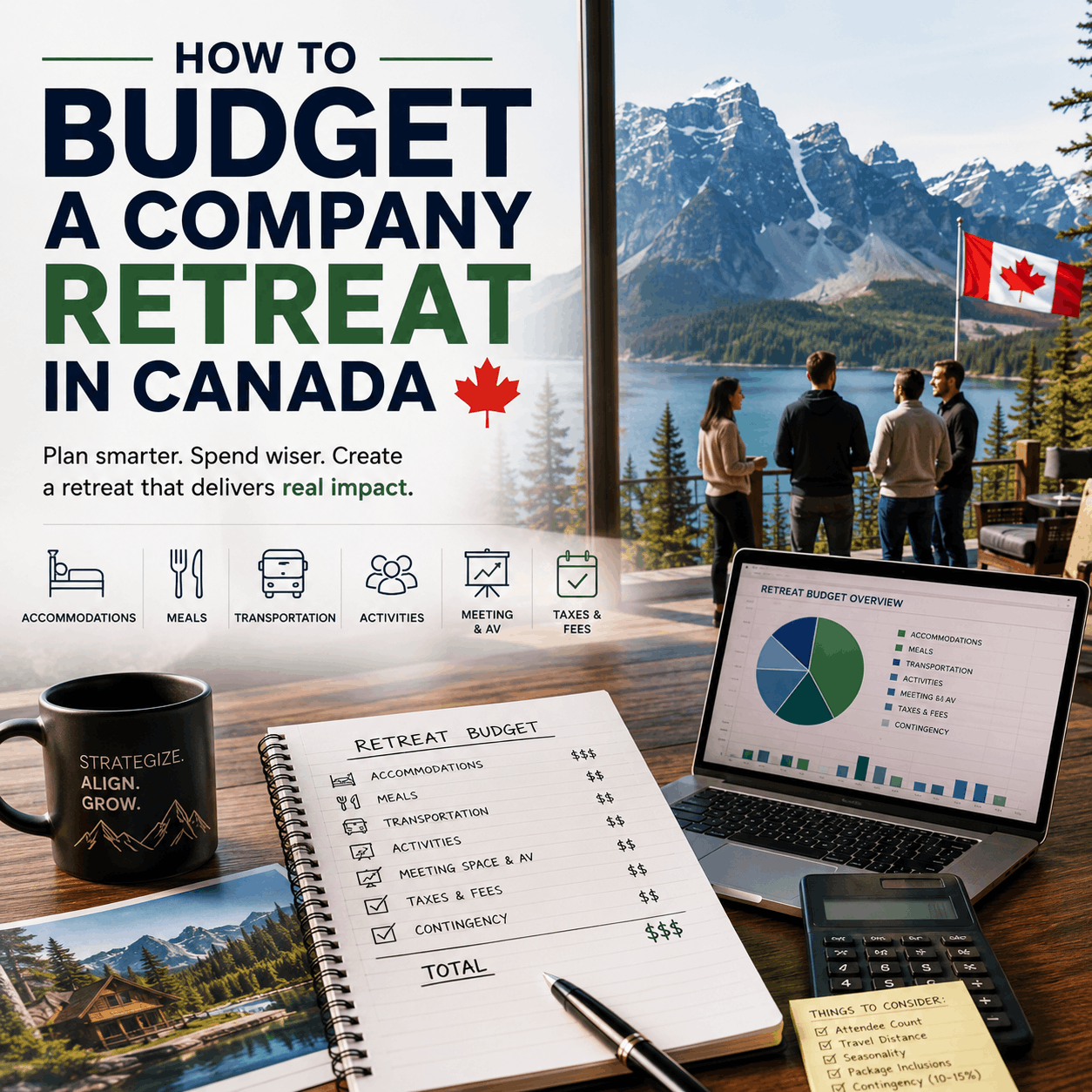
A company retreat sounds simple at first.
Pick a nice place. Bring the team. Do some planning. Eat something better than sad office sandwiches. Maybe add a lake, a mountain, a bonfire, or at least a meeting room that does not smell like printer toner.
Then the budget starts moving.
Flights. Hotels. Meeting space. Meals. Transfers. Activities. Taxes. Gratuities. AV. Cancellation rules. Dietary needs. That one person who books late. That one executive who wants “simple but premium.” Suddenly, your retreat budget is no longer a budget. It is soup.
The good news: budgeting a company retreat in Canada is very manageable if you break it into the right pieces from the start.
This guide gives you a practical way to estimate your retreat cost, avoid surprise charges, and decide what level of retreat actually makes sense for your team.
Start With the Real Purpose of the Retreat
Before you touch the budget, define the purpose.
Not the pretty purpose. The real one.
Are you trying to:
- Align leadership on strategy?
- Reward the team after a major year?
- Bring remote employees together?
- Train managers?
- Fix communication issues?
- Host clients or partners?
- Build culture after growth, layoffs, restructuring, or expansion?
This matters because the purpose decides where the money should go.
A leadership strategy retreat needs privacy, meeting flow, facilitation, and quiet space. A company celebration needs food, atmosphere, activities, and energy. A remote team retreat needs travel coordination, flexible arrivals, and enough unstructured time for people to actually connect.
A common mistake is budgeting for the wrong retreat. You say “strategy,” but spend like it is a party. Or you say “team bonding,” but trap everyone in a windowless meeting room for eight hours. That is not a retreat. That is a hostage situation with coffee.
The Simple Company Retreat Budget Formula
Use this starting formula:
Total retreat budget =
People x nights x core per-person cost
+ transportation
+ meeting space and AV
+ activities
+ taxes, fees, and gratuities
+ 10–15% contingency
For most Canadian retreats, your major categories will be:
| Budget Category | What It Includes |
|---|---|
| Accommodations | Hotel rooms, resort rooms, cabins, cottages, room taxes, resort fees |
| Meals and beverages | Breakfasts, lunches, dinners, coffee breaks, snacks, dietary requests |
| Transportation | Flights, charter buses, airport transfers, local shuttles, parking |
| Meeting space | Boardroom, ballroom, breakout rooms, private dining areas |
| AV and tech | Screens, microphones, speakers, projectors, hybrid meeting setup |
| Activities | Team-building, guides, excursions, wellness, entertainment |
| Facilitation/content | Speakers, trainers, workshop materials, printed items |
| Admin and staffing | Planning time, on-site coordinator, event staff, security if needed |
| Taxes and service charges | GST/HST, PST, municipal hotel taxes, gratuities, supplier fees |
| Contingency | Late changes, upgrades, weather alternatives, unexpected costs |
The cleanest retreat budgets are not the cheapest. They are the ones where every dollar has a job.
What Does a Company Retreat in Canada Cost?
The honest answer: it depends heavily on city, season, group size, destination, travel distance, and how fancy the retreat needs to be.
But for early planning, these ranges are useful:
| Retreat Type | Planning Range |
|---|---|
| Local day retreat, no overnight stay | $150–$450 per person |
| One-night retreat within driving distance | $650–$1,300 per person |
| Two-night Canadian retreat, practical/mid-range | $1,200–$2,500 per person |
| Premium fly-in retreat or luxury destination | $2,500–$5,000+ per person |
These are planning ranges, not quotes. A two-night retreat in a shoulder-season Ontario resort will not price the same as a peak-season Banff retreat with flights, upgraded dining, private guides, and premium meeting space.
For example, some Canadian retreat venues package rooms, meeting space, meals, and amenities together. Bayview Wildwood in Muskoka describes corporate packages that include accommodations, meals, meeting space, Wi-Fi, parking, amenities, and team-building options in one place. Calabogie Peaks listed a 2026 shoulder-season corporate meeting package with single occupancy at $209 per person per night and double occupancy at $169 per person per night, including breakfast, parking, meeting room setup, screen/projector, Wi-Fi, taxes, and gratuities.
That is why the first budget question should not be “What is the cheapest place?”
The better question is:
What can we package together so the budget stays controlled?
Sample Budget: 25-Person, Two-Night Company Retreat in Canada
Here is a simple planning example for a 25-person Canadian retreat within driving distance.
| Item | Estimate |
|---|---|
| Accommodations: $225 x 25 people x 2 nights | $11,250 |
| Meals and coffee breaks: $150 x 25 people x 2.5 days | $9,375 |
| Meeting room and basic AV | $1,500 |
| Team activity: $100 x 25 people | $2,500 |
| Local transfers or shuttle support | $1,875 |
| Facilitation, materials, admin | $2,500 |
| Estimated taxes, fees, gratuities | $4,350 |
| Contingency: 12% | $4,000 |
| Estimated Total | $37,350 |
| Estimated Cost Per Person | $1,494 |
This does not include flights. If your team is coming from multiple provinces, airfare can quickly become one of the largest budget items.
The Big Cost Drivers
1. Destination
Canada gives you a wide range of retreat styles: city hotels, lakeside resorts, mountain lodges, wineries, cabins, ski towns, conference centres, and nature retreats.
A retreat near Toronto, Vancouver, Calgary, Montreal, or Ottawa may reduce transportation complexity. A more scenic destination may increase transfers but improve the actual retreat experience.
Banff, for example, has a wide range of meeting spaces from simple rooms to large conference spaces, and groups can fly into Calgary International Airport before driving about 90 minutes to Banff. That may be worth it for an executive retreat, but probably not for a one-day operations meeting.
2. Season
Season can make or break the budget.
Peak summer, ski season, long weekends, and major event dates can raise rates. Shoulder seasons are often better for corporate retreats because venues have more availability, teams get better value, and the destination is less crowded.
Translation: your budget may behave better when everyone else is not also trying to be there.
3. Rooming Style
Single occupancy costs more but is usually better for employee comfort.
Shared rooms reduce the budget, but they can create HR and comfort issues if handled poorly. For corporate retreats, single occupancy is often the cleaner default unless the group is small, informal, and clearly comfortable sharing.
4. Food and Beverage
Meals are not just meals. They are schedule control.
A retreat with good food keeps people on site, on time, and in a better mood. A retreat with weak food turns into scattered Uber Eats, delayed sessions, and quiet resentment.
Budget for:
- Breakfast
- Lunch
- Dinner
- Coffee breaks
- Snacks
- Dietary restrictions
- Non-alcoholic beverages
- Alcohol, if appropriate
- Gratuities and service charges
For work-related hospitality functions, CRA notes that meals or hospitality services may be non-taxable to employees when they are part of a work-related event, the employer is the primary beneficiary, the cost is reasonable, and the event is not mainly a celebration or reward. For deductibility, CRA generally limits food, beverage, and entertainment expense claims to 50% of the lesser of the actual amount or a reasonable amount. Always confirm the tax treatment with your accountant.
5. Transportation
Transportation can include:
- Flights
- Airport transfers
- Chartered buses
- Train tickets
- Rental vehicles
- Parking
- Local shuttles
- Late arrival support
For Canadian company retreats, the most budget-friendly format is often a destination within driving distance of a major city. It reduces flight costs, simplifies arrivals, and gives the planning team fewer moving parts to babysit.
6. Meeting Space and AV
Never assume meeting space is free just because you booked rooms.
Ask clearly:
- Is the meeting room included?
- How many hours are included?
- Is setup included?
- Are breakout rooms extra?
- Is Wi-Fi included?
- Are screen, projector, microphones, speakers, and adapters included?
- Is there a technician on site?
- Is hybrid meeting support available?
The AV line is where many retreat budgets quietly get bitten.
7. Activities
Activities should support the purpose of the retreat.
For a leadership team, that may be a guided strategy session, private dinner, or nature walk. For a full company retreat, it may be team-building, wellness, local tours, games, or a casual evening event.
The best activity is not always the most expensive one. Sometimes a bonfire, lake walk, or guided city experience does more than a forced trust fall ever could.
Please stop making adults do awkward trust exercises unless you are very sure they deserve it.
Canada-Specific Budget Items to Watch
GST/HST and Provincial Taxes
In Canada, GST/HST depends on the province or territory where the taxable supply is considered to be made. CRA explains that the rate depends on the place of supply, and some provinces use HST while others apply GST plus provincial sales tax separately.
This means the same retreat budget can look different depending on whether you are booking in British Columbia, Alberta, Ontario, Quebec, Nova Scotia, or another province.
Hotel and Accommodation Taxes
Accommodation taxes can also vary by destination.
For example, British Columbia applies 8% PST to short-term accommodation, and participating areas may add up to 3% Municipal and Regional District Tax. Ontario hotels may also show HST and municipal accommodation tax as separate charges, as seen in resort package pricing where 13% HST, 4% Municipal Accommodation Tax, and resort fees are additional.
Budget lesson: do not build your retreat budget from base room rates alone.
Base rate is the bait. Final invoice is the truth.
Employee Taxable Benefit Considerations
If the retreat is a social event, CRA has specific administrative rules. For an in-person social event to be non-taxable, it generally needs to be available to all employees, cost $150 or less per person including taxes, and fall within the annual limit for employer-paid social events. If the cost goes over the limit, the full amount may become taxable.
If the retreat is a work-related hospitality function, CRA looks at factors such as whether the employer is the primary beneficiary, whether the event is reasonable in cost, and whether it is not simply a reward or celebration.
This is why your retreat agenda matters. A documented business purpose, work sessions, training, planning, and clear employer benefit can help separate a legitimate business retreat from “we took everyone away for fun and vibes.”
Again, ask your accountant. This article is a planning guide, not tax advice.
Where Companies Overspend
Companies usually overspend in five places:
1. Booking Too Late
Late planning means fewer rooms, worse rates, limited meeting space, and expensive transportation.
For a small retreat, start planning at least 2–3 months ahead. For a larger retreat, multi-city team, or premium destination, start 4–6+ months ahead.
2. Choosing the Destination Before the Budget
The destination should match the budget, not bully it.
Pick the retreat goal, group size, travel radius, and budget range first. Then compare destinations.
3. Ignoring Transfer Costs
A resort may look affordable until you realize everyone needs a private shuttle from an airport two hours away.
Transportation is not a side quest. It is part of the retreat.
4. Underestimating Food
People remember food.
They may forget the third slide of the strategy deck. They will not forget being hungry at 3:00 p.m. while someone explains quarterly priorities.
5. No Contingency
Always add 10–15%.
Not because you are careless. Because reality likes to improvise.
How to Reduce Retreat Costs Without Making It Feel Cheap
Here are practical ways to control the budget:
- Choose shoulder season dates.
- Stay within driving distance of a major city.
- Use one venue for rooms, meals, meetings, and activities.
- Ask for packaged pricing.
- Limit alcohol to one hosted reception or fixed drink tickets.
- Choose breakfast-included properties.
- Use group transfers instead of individual rides.
- Avoid peak arrival and departure times.
- Keep activities simple but meaningful.
- Build the agenda around fewer, better moments.
The goal is not to cut everything. The goal is to remove waste.
A good retreat does not need to be extravagant. It needs to be clear, well-paced, easy to attend, and worth leaving the office for.
A Practical Retreat Budget Checklist
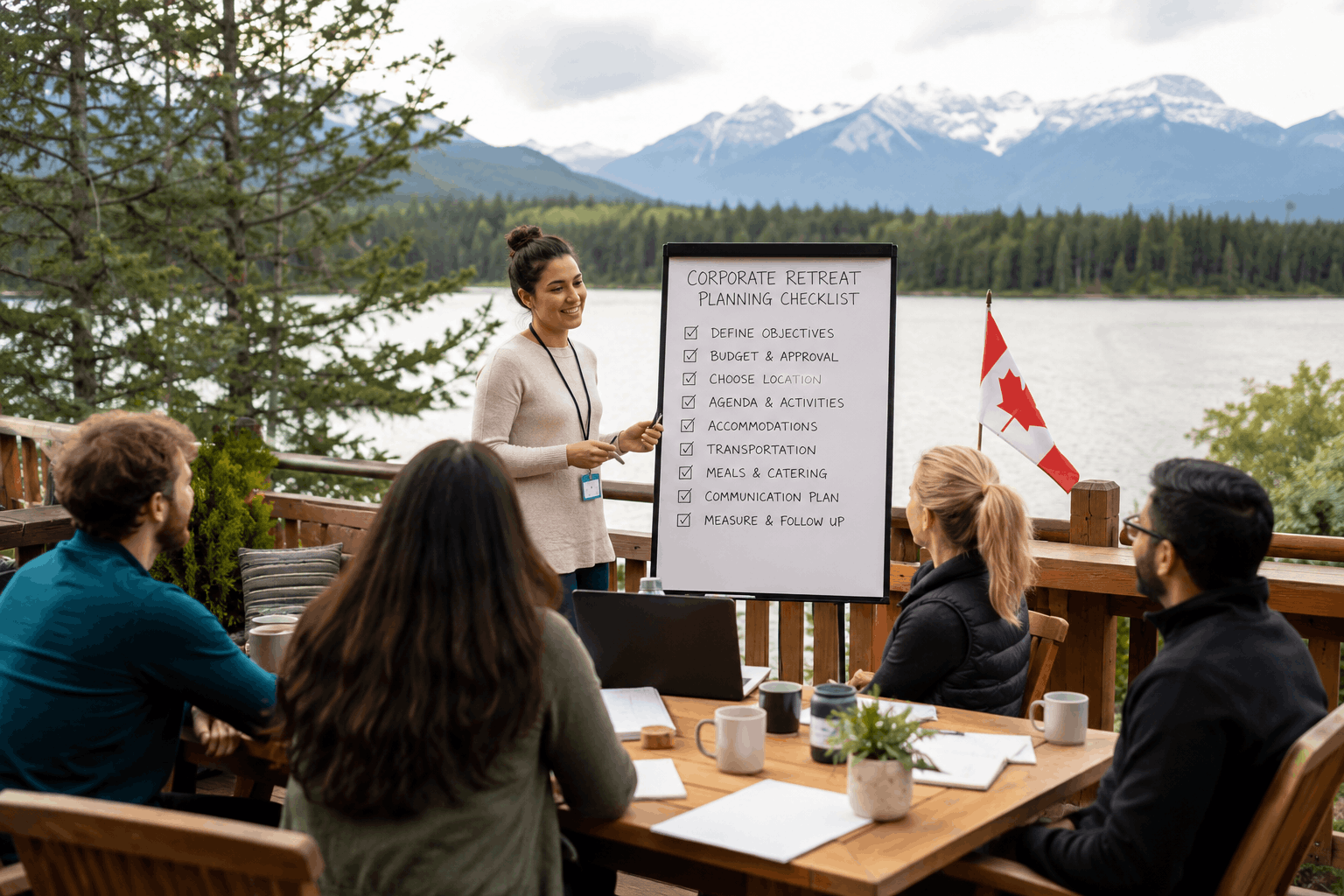
Before you approve the budget, confirm:
- Final attendee count
- Rooming list and single/shared occupancy
- Arrival and departure patterns
- Full accommodation quote with taxes and fees
- Meeting room inclusions
- AV inclusions and extra charges
- Meal plan and dietary handling
- Coffee break pricing
- Alcohol policy and limits
- Activity pricing
- Transportation plan
- Cancellation and attrition terms
- Payment schedule and deposits
- Insurance requirements
- Accessibility needs
- Contingency amount
- Internal tax/accounting review
If you cannot answer these, your budget is not finished yet. It is just a hopeful number wearing a suit.
Final Thought: Budget for the Retreat You Actually Need
A company retreat in Canada can be a powerful investment when it is planned properly.
It can align leadership, reconnect remote teams, reward employees, train managers, build trust, and create the kind of conversations that never happen inside a normal workday.
But the budget has to be honest.
Do not start with the dream itinerary. Start with the business reason, the attendee count, the travel reality, and the total spend your company is actually comfortable with. Then design the best possible retreat inside that frame.
That is how you avoid chaos.
That is how you get a retreat people remember for the right reasons.
And that is how the spreadsheet stays a tool instead of becoming the villain.
Need Help Planning a Company Retreat in Canada?
Globalduniya helps companies plan practical, well-organized retreats across Canada, including accommodations, group flights, transportation, activities, and custom travel coordination.
Whether you are planning a leadership offsite, team retreat, incentive trip, or corporate getaway, we can help you compare options and build a budget before you commit.
Contact Globalduniya to start planning your company retreat in Canada.

Comments
0 comments
No comments yet
Be the first to add a thought or question about this article.