
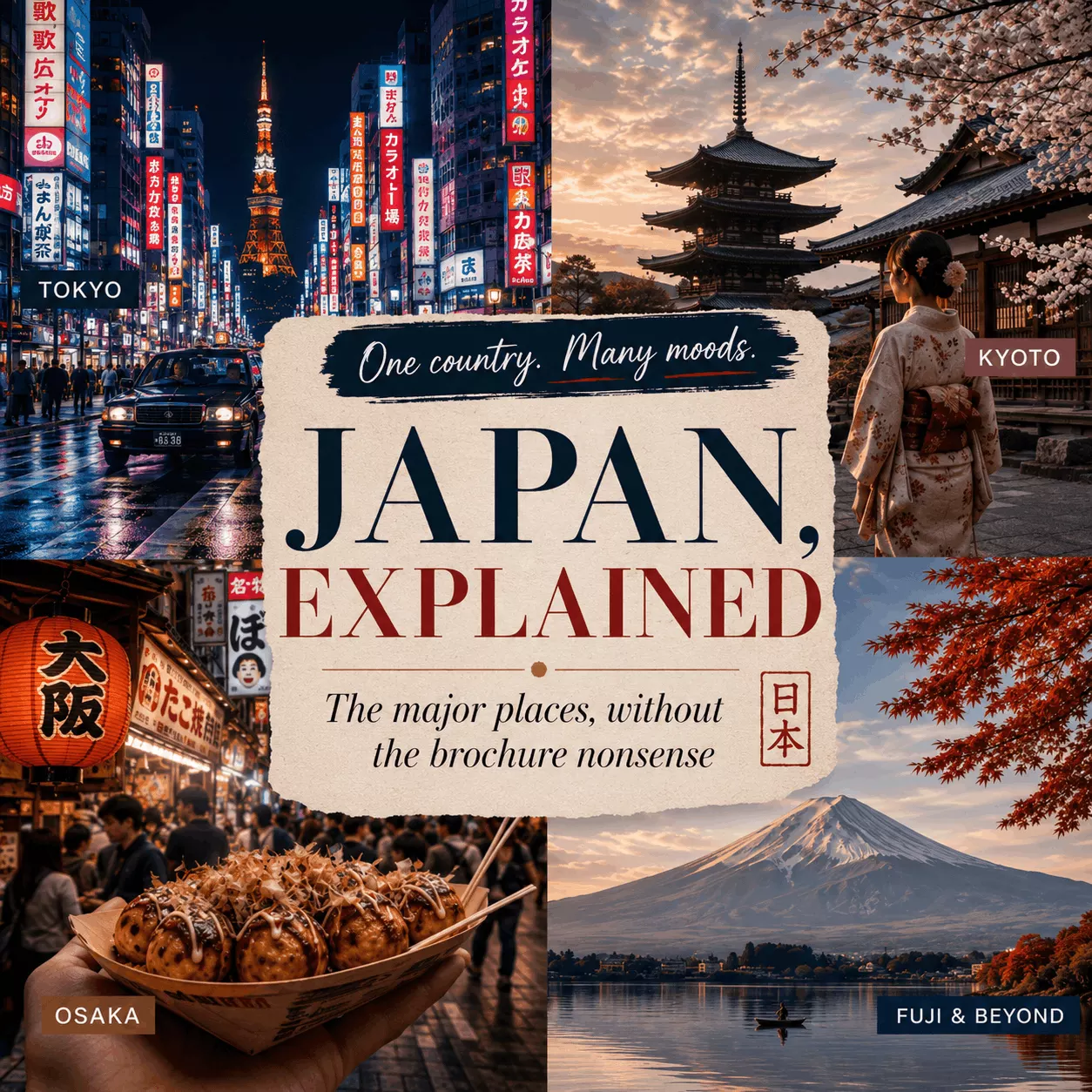
Most people plan Japan like they are trying to complete a checklist.
Tokyo. Kyoto. Osaka. Mount Fuji. Maybe Hiroshima if they have extra days. Maybe Nara if they saw a deer on Instagram and decided, yes, this is now culture.
And honestly, fair enough.
Japan does have the classics for a reason. The problem is not that people visit the obvious places. The problem is that they do not understand what each place is for.
Because Japan is not one single mood.
It is not just anime, sushi, temples, bullet trains, vending machines, polite people, and that one crossing in Shibuya where everyone pretends they are in a music video.
Japan is layered.
There is the Japan of neon and noise.
The Japan of old wood and temple bells.
The Japan of street food, laughter, and “just one more bite.”
The Japan of mountains, snow, hot springs, islands, forests, ghosts, trains, convenience stores, and tiny perfect systems that make you wonder why the rest of the world is held together with duct tape and vibes.
So this guide is not a “top 10 places to visit in Japan” list.
This is a quick map of the major regions, what they actually feel like, and who they are best for.
Because the wrong Japan is still beautiful.
But the right Japan?
That one gets under your skin.
Tokyo: The Electric Fever Dream
Tokyo is usually where people begin, and that makes sense.
It is the easiest place to land, the easiest place to get overwhelmed, and the easiest place to convince yourself that you are both extremely alive and slightly underqualified to use a train station.
Tokyo is not really a city in the normal sense. It is more like several cities stacked on top of each other, each pretending the others are none of its business.
Shibuya is youth, movement, fashion, screens, crossings, chaos.
Shinjuku is nightlife, towers, tiny bars, and “how is this still going at 1 AM?”
Asakusa is old Tokyo, temples, lanterns, snacks, and the feeling that the past is still peeking through the concrete.
Ginza is polished luxury.
Akihabara is anime, games, electronics, and controlled sensory overload.
Harajuku is style, rebellion, cuteness, and the strange human need to become a walking concept.
Tokyo is best for people who want energy.
Not peace. Not yet.
Tokyo is the engine starting.
Go here for food, shopping, nightlife, anime culture, museums, fashion, city photography, and the feeling that every street corner has another tiny world hiding behind it.
Stay 3 to 5 nights if it is your first trip. More if you like cities. Less if you are the kind of person who says “I just want somewhere quiet” and then becomes spiritually defeated by a subway map.
Kyoto: The Beautiful Trap
Kyoto is the Japan everyone thinks they are going to find.
Temples. Shrines. Bamboo groves. Tea houses. Wooden streets. Kimono photos. Moss gardens. Quiet alleys. That old-world feeling people chase when they say they want “authentic Japan,” as if authenticity is a souvenir you can buy beside matcha ice cream.
And Kyoto is beautiful.
Annoyingly beautiful.
But Kyoto is also the place where bad planning hurts the most.
Because everyone wants the same dream at the same time. Fushimi Inari, Kiyomizu-dera, Arashiyama, Gion — these places can be magical, but they can also become a slow parade of selfie sticks and exhausted tourists pretending they are having a spiritual experience.
Kyoto rewards patience.
Go early. Walk deeper. Do fewer things. Let the city breathe.
The mistake is trying to “cover” Kyoto.
You do not cover Kyoto.
Kyoto punishes the greedy.
You choose a few areas, move slowly, and let the old city reveal itself when it feels like it.
Kyoto is best for temples, gardens, traditional streets, tea culture, history, photography, and that soft aching feeling of being somewhere older than your own worries.
Stay 2 to 4 nights. But do not treat it like a museum speedrun.
Osaka: The Hungry Friend
Osaka is not trying to impress you in the same way Kyoto does.
Osaka does not stand under a lantern whispering, “Look how ancient I am.”
Osaka grabs you by the shoulder and says:
“Are you hungry?”
And that is why Osaka is wonderful.
This is the city for eating, laughing, wandering, and letting the trip loosen up. Dotonbori is loud, bright, ridiculous, and yes, touristy, but it works because Osaka has never been embarrassed by excess.
Takoyaki. Okonomiyaki. Kushikatsu. Ramen. Street snacks. Izakayas. Tiny restaurants where you sit down and immediately realize the menu has no English and your courage has left the building.
Osaka is also a strong base for day trips. Kyoto, Nara, Kobe, Himeji — all can be reached fairly easily from here.
Tokyo is the machine.
Kyoto is the memory.
Osaka is the appetite.
Stay 2 to 4 nights, especially if you like food, nightlife, casual wandering, and cities with personality.
Osaka is not always elegant.
Good.
Not everything needs to enter the room wearing linen.
Nara: Deer, Temples, and Mild Betrayal
Nara is usually done as a day trip from Osaka or Kyoto.
People go for the deer.
This is understandable. The deer are iconic. They bow. They pose. They steal crackers. They have the energy of tiny forest gangsters who discovered tourism and monetized cuteness.
But Nara is not just deer.
Todai-ji Temple is genuinely powerful. The Great Buddha Hall has weight to it — not just size, but presence. Nara Park is lovely, and if you walk beyond the busiest areas, the place becomes calmer and more atmospheric.
Nara is best as a one-day trip for first-timers.
Go for the deer. Stay for the old capital energy.
But keep your crackers guarded.
Respectfully, those deer are running an operation.
Mount Fuji and Hakone: The Symbol and the Soak
Mount Fuji is strange because it is both overused and still absolutely worth seeing.
It has been printed on postcards, paintings, logos, mugs, T-shirts, travel posters, and probably someone’s questionable lower-back tattoo. And yet, when you actually see it on a clear day, the cliché shuts up.
Fuji works best when paired with either the Fuji Five Lakes area or Hakone.
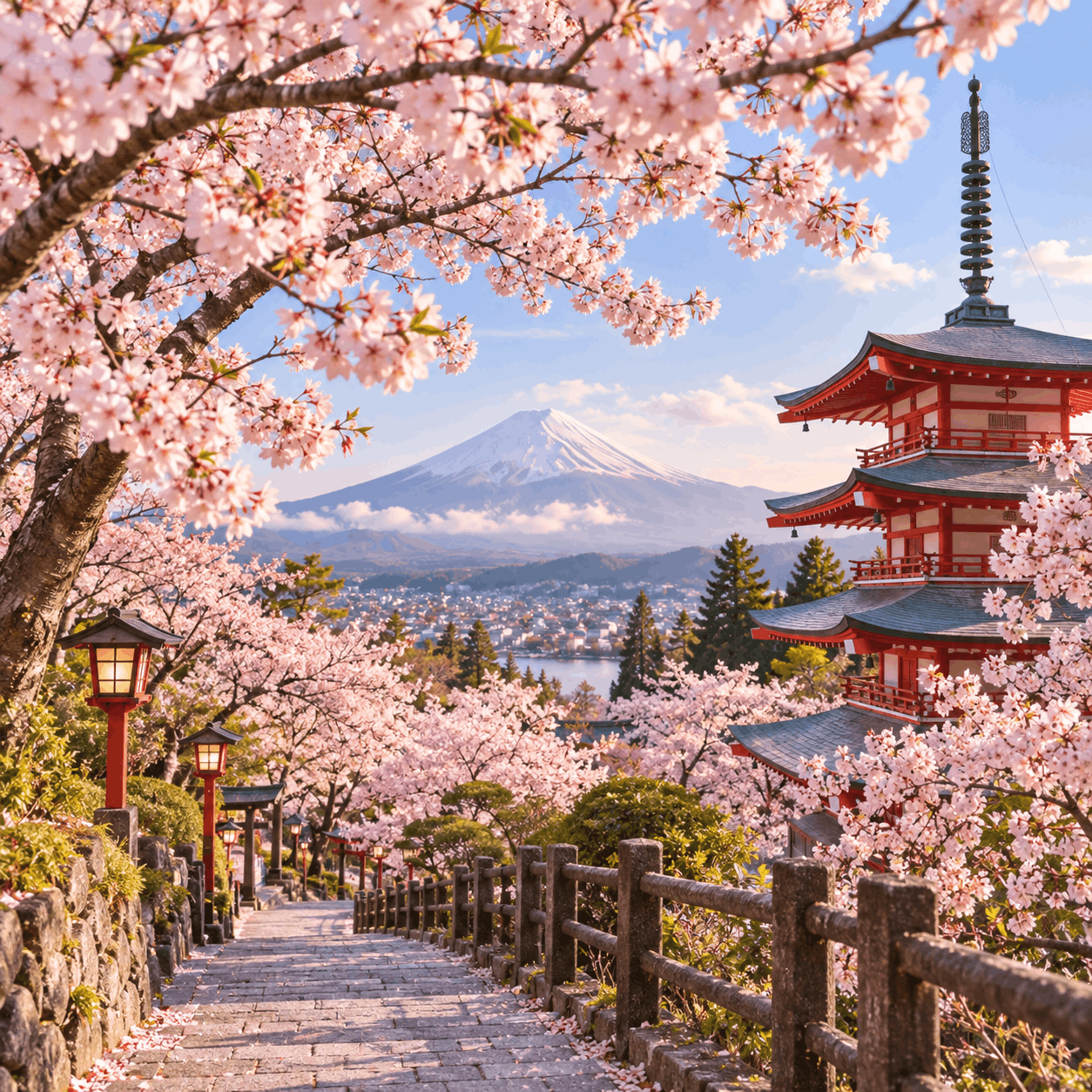
The Fuji Five Lakes area, especially around Kawaguchiko, is better if you want views of the mountain itself. This is where you go for the postcard version: Fuji across the water, Fuji behind a pagoda, Fuji standing there like it knows it is the main character.
Hakone is more about hot springs, ryokan stays, ropeways, lake views, and a softer nature escape from Tokyo.
If Tokyo is the engine, Fuji/Hakone is where the steam rises off the machine.
This area is best for couples, first-timers wanting a classic view, hot spring experiences, ryokan stays, and people who want a break from the cities without going too far.
Stay 1 to 2 nights.
Do not rely on seeing Fuji perfectly. The mountain has diva energy. Some days it appears. Some days it refuses the stage.
Hiroshima and Miyajima: The Heavy Heart and the Floating Gate
Hiroshima is not a place to consume casually.
It asks for a different kind of attention.
The Peace Memorial Museum and Peace Park are important, but they are not just “things to do.” They are places that change the tone of the trip. You do not go there between snacks and shopping like it is another checkbox.
You give it room.
And then nearby Miyajima gives the journey a different breath.
The floating torii gate at Itsukushima Shrine is one of Japan’s most recognizable sights, but the island itself is also worth time. Deer wander around, Mount Misen rises above, and the whole place feels slower, more sacred, more held.
Hiroshima and Miyajima work well together because they give contrast.
Memory and beauty.
Weight and release.
Human history and the quiet persistence of the sea.
Stay 1 to 2 nights if your route allows it.
This is best for people who want their trip to have emotional depth, not just pretty photos and convenience store egg sandwiches — though yes, those sandwiches are also somehow spiritually important.
Hokkaido: Japan Exhales
Hokkaido is the Japan people often skip on a first trip, mostly because it is farther north and does not fit easily into the classic Tokyo-Kyoto-Osaka route.
But Hokkaido is gorgeous.
It is wide, spacious, snowy in winter, flower-filled in summer, and much less dense than the major cities. It feels like Japan took off its tight shoes.
Sapporo is the main city, known for food, beer, winter festivals, and as a gateway to the rest of the region. Niseko is famous for skiing. Furano and Biei are known for lavender fields and rolling landscapes. The national parks are excellent for nature lovers.
Hokkaido is best for repeat visitors, winter trips, skiing, road trips, food lovers, and people who want Japan without being pressed into crowds every 14 seconds.
If the main Golden Route is Japan’s greatest hits album, Hokkaido is the slower side project where the artist actually breathes.
Stay 4 to 7 nights if you are doing it properly.
Do not add Hokkaido randomly to a short first trip unless you have a very specific reason. It deserves space.
Okinawa: Japan, But the Sea Is in Charge
Okinawa is different.
It is still Japan, but it carries its own rhythm, history, climate, food, and island identity. It feels less like the mainland and more like a separate melody that got woven into the same song.
People go for beaches, diving, snorkeling, island-hopping, warm weather, and a more relaxed pace.
Naha is the main entry point. From there, travellers can explore Okinawa Island or continue to other islands like Ishigaki, Miyakojima, or the Kerama Islands.
Okinawa is not the best choice if your dream Japan is temples, bullet trains, ramen alleys, and neon nights.
Okinawa is for ocean, warmth, slower days, and people who want their Japan trip to drift instead of sprint.
It is best for beach lovers, divers, families, second-time visitors, and anyone who wants to pair Japan with a tropical escape.
Stay 4 to 6 nights.
Mainland Japan runs on precision.
Okinawa lets the edges soften.
Kanazawa: Kyoto’s Quieter Cousin
Kanazawa is often described as an alternative to Kyoto, which is both useful and slightly unfair.
It has traditional districts, gardens, samurai history, tea houses, crafts, seafood, and one of Japan’s most famous gardens, Kenrokuen.
But Kanazawa is not just “Kyoto with fewer people.”
It has its own elegance. Less obvious, less shouted about, less crushed by the first-timer machine.
Kanazawa is good for travellers who want culture, beauty, and history, but do not want every moment to feel like they are walking inside someone else’s itinerary.
Stay 1 to 2 nights.
It pairs well with Takayama, Shirakawa-go, or a route between Tokyo and Kyoto if you want to break away from the most standard path.
Kanazawa is not the loud answer.
That is the charm.
Takayama and Shirakawa-go: Old Mountain Japan
Takayama is a mountain town with old streets, morning markets, sake breweries, and a slower rhythm. It feels more intimate than the big cities and gives travellers a sense of rural, historical Japan without needing to vanish into the wilderness.
Shirakawa-go, nearby, is famous for its traditional thatched-roof farmhouses. In winter especially, it looks almost unreal, like someone built a village out of memory and snow.
This region is best for people who want old towns, mountain scenery, rural atmosphere, photography, and a slower break between major cities.
Stay 1 to 2 nights in Takayama. Shirakawa-go can be done as a day trip or stopover.
This is not the place for nightlife.
This is the place where you walk slowly and remember that human beings used to build things with seasons in mind, not just parking lots and deadlines.
Kobe and Himeji: Easy Add-Ons from Osaka
Kobe is a stylish port city near Osaka, known for food, harbor views, and a more international feel. It is easy to visit for a half-day or day trip.
Himeji is famous for Himeji Castle, one of Japan’s most beautiful and important castles. Unlike some reconstructed castles, Himeji feels like it carries real historical weight.
These are not usually the emotional center of a first Japan trip, but they are strong additions if you have extra time around Osaka.
Kobe is for a relaxed food-and-harbor day.
Himeji is for people who want a proper castle and not a concrete box wearing a historical costume.
Fukuoka and Kyushu: The Underrated Door
Fukuoka is one of Japan’s most underrated major cities for travellers.
It has great food, especially ramen, a relaxed urban feel, access to nearby nature, and a warmer southern energy. It is easier-going than Tokyo and less tourist-dense than Kyoto.
Kyushu as a whole is excellent for people interested in hot springs, volcanoes, road trips, regional food, and a different side of Japan.
Beppu, Yufuin, Kumamoto, Nagasaki, Kagoshima — each opens a different door.
This is better for second-time visitors or first-timers with a longer trip and a little more curiosity.
Kyushu feels like the part of Japan that says:
“You have seen the famous face. Good. Now come around the side entrance.”
Stay 4 to 7 nights if exploring the region.
So, Where Should You Go First?
For most first-timers, the classic route still works:
Tokyo → Kyoto → Osaka, with possible day trips to Nara, Hakone/Fuji, or Hiroshima/Miyajima.
That route works because it gives you contrast.
Tokyo gives you the modern pulse.
Kyoto gives you the old atmosphere.
Osaka gives you food and looseness.
Nara gives you deer with organized-crime energy.
Fuji gives you the icon.
Hiroshima and Miyajima give the trip emotional weight and release.
But the best Japan itinerary is not the one with the most pins on Google Maps.
It is the one where the rhythm makes sense.
Some people need the city first.
Some need nature.
Some need food.
Some need anime shops and arcades.
Some need temples.
Some need hot springs.
Some need to stand in a 7-Eleven at midnight eating an egg sandwich and wondering why life is suddenly okay.
Japan can do all of that.
But not all in one trip.
That is the trick.
You do not need to see all of Japan the first time.
You need to meet the right version of Japan first.
The rest can wait.
Japan is very good at waiting.


Comments
0 comments
No comments yet
Be the first to add a thought or question about this article.